
Direct-to-Consumer Generic Pharmacies: How Much You Really Save vs. Insurance
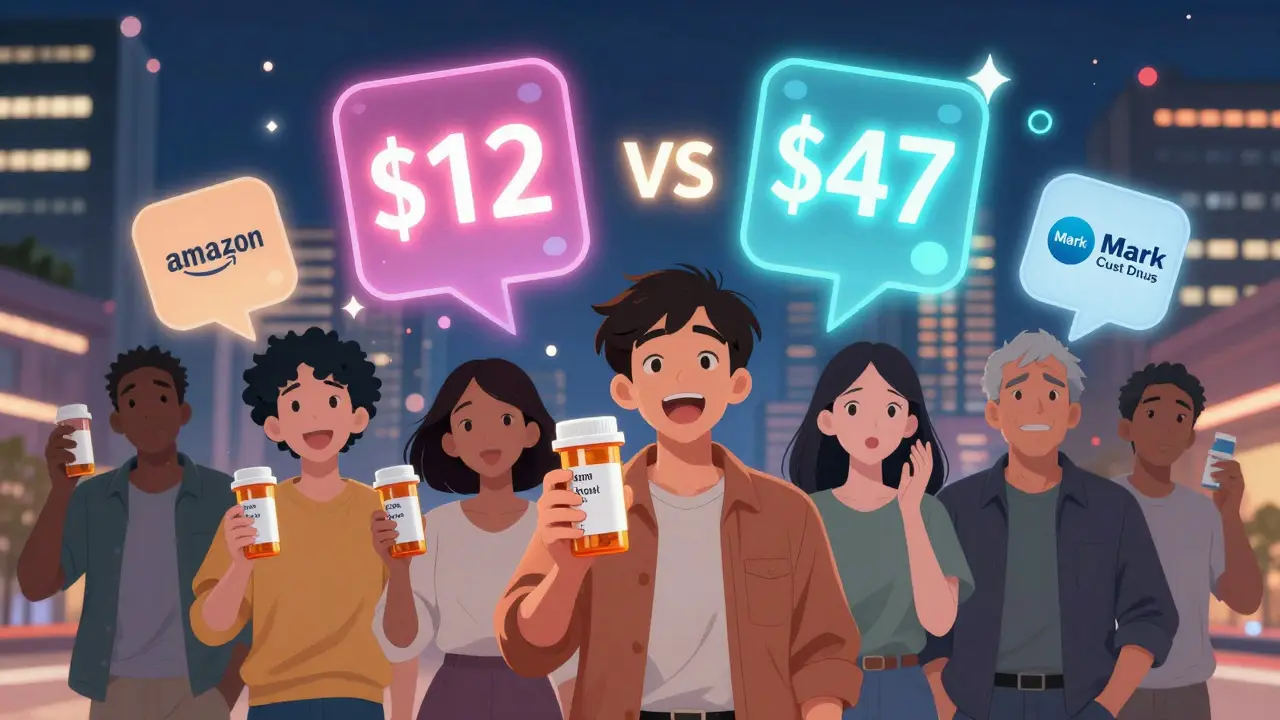
Imagine filling a prescription for your blood pressure medication and paying $12 instead of $47. Or picking up your diabetes pills for $8 instead of $35. That’s not a fantasy-it’s what some people are doing with direct-to-consumer (DTC) generic pharmacies. But here’s the catch: for many others, sticking with insurance still saves more money. The truth isn’t simple. It depends on what drugs you take, where you live, and how much time you’re willing to spend comparing prices.
What Exactly Are DTC Pharmacies?
Direct-to-consumer pharmacies are online drug sellers that cut out the middleman. No insurance. No pharmacy benefit managers (PBMs). No hidden rebates. You pay cash, and they give you a price upfront. Companies like Mark Cuban Cost Plus Drug Company, Amazon Pharmacy, Costco, Walmart, and Health Warehouse built these models to be transparent. Mark Cuban’s company, for example, adds just a 15% markup to the actual cost of the drug. No secret negotiations. No surprise bills. These services exploded after 2020. People were tired of paying $50 for a $2 generic because their insurance plan had a high deductible or weird copay tiers. DTC pharmacies promised a way out. And for some drugs, they delivered big savings.Where the Big Savings Happen
Not all generics are created equal. There are two kinds: common ones and expensive ones. And the savings look totally different for each. Expensive generics are drugs that cost a lot even though they’re off-patent. Think of drugs like Imbruvica (ibrutinib) or Revlimid (lenalidomide) generics-used for cancer or autoimmune conditions. These used to cost hundreds or even over $1,000 a month. In 2024, a study in the Journal of General Internal Medicine found that DTC pharmacies slashed those prices by an average of 76%. The median savings? $231 per prescription. That’s not a small discount. That’s life-changing money for someone paying out of pocket. Amazon Pharmacy led in lowest prices for 47% of these expensive generics. Mark Cuban Cost Plus Drug Company came in second at 26%. Costco and Health Warehouse filled in the rest. If you’re on a high-cost drug, checking these sites could save you hundreds each month.Where DTC Pharmacies Fall Short
But here’s where it gets messy. For common generics-the ones you take every day for blood pressure, cholesterol, or thyroid issues-the savings shrink. The same study found median savings of just $19 per prescription. That’s 75% off retail, sure. But retail prices for these drugs are already low. At Walmart, you can get 30 days of lisinopril for $4. At Costco, it’s $3. So why go through the hassle of signing up for a new pharmacy website, waiting for shipping, and checking multiple sites? Worse, one in five of the most expensive generics aren’t even available through any DTC pharmacy. If you need a rare drug for a complex condition, you might find nothing on Amazon, nothing on Mark Cuban’s site, nothing on Health Warehouse. You’re stuck going back to your insurance pharmacy-or paying full retail.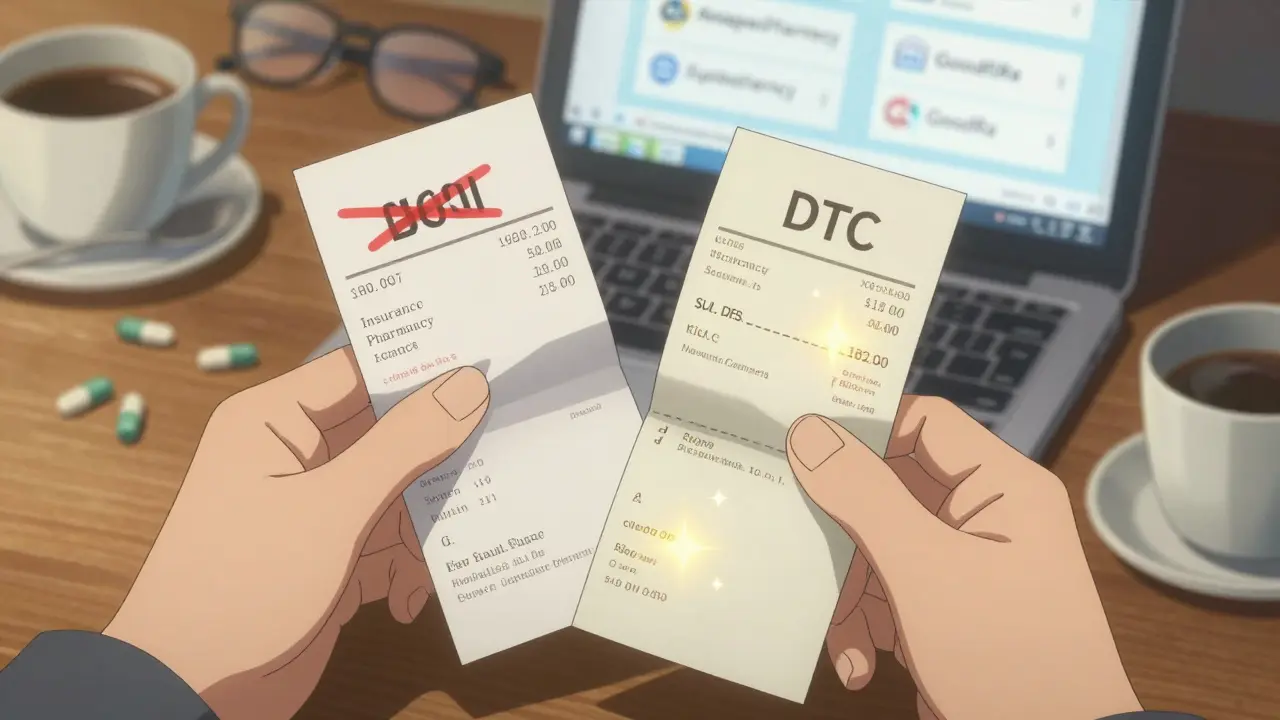
Why Insurance Sometimes Wins
This is the part most people miss. If you have good insurance, especially Medicare Part D, you might already be paying less than you think. USC Schaeffer Center research showed that 90% of commonly prescribed generics in Medicare Part D cost less than $20 for a 30-day supply at Costco. And that’s cash price. With insurance, your copay is often $5 or $10. Then there’s the CVS Health study from 2023. They looked at 79 neurological generics-drugs for epilepsy, Parkinson’s, migraines. They found that Mark Cuban’s pharmacy carried only 33 of them. And of those 33, only two were cheaper than what insured patients paid out of pocket through their PBM. For the rest, insurance saved more money. Why? Because PBMs negotiate deep discounts with manufacturers that DTC pharmacies can’t match. They also bundle drugs into formularies that lower costs across the board. If you’re on a plan with good coverage, your insurer is already doing the price shopping for you.Who Benefits Most From DTC Pharmacies?
You’re the best candidate for DTC pharmacies if:- You’re uninsured or underinsured
- You take one or two expensive generic drugs
- You’re willing to spend 10-15 minutes comparing prices across 3-5 sites
- You don’t need your medication immediately (most DTC pharmacies take 3-7 days to ship)
The Real Problem: No Easy Tool Exists
The biggest barrier isn’t price. It’s complexity. Right now, there’s no single website or app that shows you the lowest price for your exact prescription across all options: your insurance pharmacy, GoodRx, Amazon, Mark Cuban, Costco, Walmart, and local stores. You have to do it manually. You type in your drug name, strength, quantity. Then you click through each site. Then you compare. The lead researcher of the 2024 study said it plainly: “There are no simple, accurate, and comprehensive tools to help patients identify the lowest-cost generic drug across all pharmacy channels.” That’s not just inconvenient. It’s unfair. People managing diabetes, heart disease, or depression shouldn’t have to become price detectives just to afford their meds.What You Should Do Right Now
Here’s a practical plan-no fluff, just action:- Make a list of every medication you take, including the exact name, strength, and how often you refill.
- Go to GoodRx.com and check the cash price for each at your local pharmacy.
- Now check Amazon Pharmacy, Mark Cuban Cost Plus Drug Company, and Costco’s online pharmacy. Enter the same drug details.
- If you’re on Medicare, check your plan’s formulary and your out-of-pocket cost.
- For expensive drugs (over $100/month), if DTC is 50% cheaper, use it. For common drugs (under $20), stick with your insurance or Costco if it’s cheaper.
- Call your doctor. Ask if there’s a therapeutic alternative that’s cheaper. Sometimes switching from one generic to another saves you $50 a month.
The Future: Will This Change?
There’s momentum. More people are asking for transparency. More lawmakers are pushing to ban secret rebates. And tech companies are watching. One day, there might be a free app that pulls real-time prices from all pharmacies and tells you, “Fill this at Costco for $3.50” or “Use Mark Cuban’s site for $89 instead of your $120 copay.” Until then, you’re on your own. But you’re not powerless. You have more control over your prescription costs than you think. You just have to be willing to look.It’s not about choosing insurance or DTC. It’s about choosing the right tool for each drug. And that’s something no algorithm can do for you yet. But you can.



Pooja Kumari
January 7, 2026 AT 17:53OMG I just found out my insulin costs $12 on Mark Cuban’s site instead of $140 with my insurance 😭 I’ve been crying every time I refill and now I feel like a genius for finally checking. I’m from India and we don’t even have this luxury here-my cousin pays $80 for metformin and calls it a miracle. Why does America make this so damn complicated? I’m telling everyone I know. This changed my life.
Now I’m crying again but for different reasons. Thank you for writing this. I didn’t know I had options. I thought I was just poor and unlucky. Turns out I was just uninformed.
Can someone explain why PBMs are allowed to exist? Like… who benefits from this? Not me. Not my grandma. Not the person with diabetes working two jobs. It’s all just greed wrapped in paperwork.
I’m gonna start a subreddit: r/DrugsNotDrama. We’ll just post prices and laugh at the system. Someone help me make it.
Also-why does Walmart have lisinopril for $4 but my pharmacy charges $18? Is this a scam? Is this legal? Someone please tell me I’m not crazy.
I’m not mad. I’m just… disappointed. In everyone. In the system. In myself for not checking sooner.
Anyway. I’m saving $130/month. That’s a Netflix subscription. A new pair of shoes. A damn vacation. I’m gonna buy myself a coffee with the savings. And I’m gonna drink it slowly. Like it’s the last one I’ll ever afford.
Thank you.
Also-can someone send me a link to the study? I want to print it and tape it to my fridge. So I remember I’m not broken. The system is.
Jacob Paterson
January 8, 2026 AT 08:19Wow. A whole article about how to not get ripped off by the healthcare system. Groundbreaking. Next up: ‘How to avoid breathing air if you don’t have insurance.’
You people act like this is some new discovery. It’s 2024. The entire system is a pyramid scheme run by lawyers and CEOs who think ‘transparency’ means putting a price tag on a heart attack. You’re all just now noticing? Congrats. You’re late to the funeral.
And yes, I know you’re proud of saving $19 on lisinopril. That’s like bragging you saved 5 cents on a $1000 TV. The real crime is that you have to do this at all. But hey-keep comparing prices. Maybe one day you’ll earn your ‘Financial Literacy’ badge from the American Healthcare™️ Achievement Awards.
Angela Stanton
January 9, 2026 AT 11:49Let’s operationalize this. The DTC pharmacy model is a supply-chain disintermediation play with direct-to-patient monetization vectors. PBMs are rent-seekers in the Rx value chain, leveraging formulary gatekeeping and rebate capture to extract surplus. The 76% median savings on high-cost generics (e.g., ibrutinib) indicates a structural misalignment between manufacturer pricing and PBM reimbursement.
But here’s the kicker: DTC platforms lack interoperability with EHRs and don’t integrate with prior auth workflows. So while you save $231 on lenalidomide, you’re now manually tracking 37 refills across 5 portals. That’s a cognitive load tax. And for polypharmacy patients? It’s not savings-it’s burnout.
Also-why is no one talking about the 1 in 5 generics that are *unavailable*? That’s not a gap. That’s a market failure. The DTC model is a bandaid on a hemorrhage.
TL;DR: You’re optimizing for price, not system resilience. And that’s why this isn’t scalable. 🤷♀️💊
Johanna Baxter
January 11, 2026 AT 01:52Jerian Lewis
January 11, 2026 AT 05:46I used to think the system was broken. Now I think it’s working exactly as intended. The people who can afford to spend hours comparing prices are the ones who already have time, internet, and stability. The rest? They’re just told to ‘take their meds’ and hope for the best.
This isn’t about savings. It’s about survival. And the fact that we’re treating medicine like a grocery store is terrifying.
I’m not mad. I’m just… tired.
Kiruthiga Udayakumar
January 11, 2026 AT 17:25People in India pay $50 for a single pill because we don’t have Walmart or Amazon Pharmacy. And here you are, arguing over $19 on lisinopril. You think this is hard? Try getting your insulin shipped from the U.S. to a village in Bihar. Try explaining to your diabetic mother why the government can’t afford to subsidize it.
Stop acting like you’re fighting a war. You’re just lucky enough to have a choice. Most of us don’t even get to pick the pharmacy.
Be grateful. Or at least shut up.
Patty Walters
January 12, 2026 AT 18:08Hey-just wanted to say you’re not alone. I did the same thing last month. Made a spreadsheet. Checked GoodRx, Amazon, Mark Cuban, Costco. Turned out my blood pressure med was $3 at Costco, but my thyroid med was $11 on Mark Cuban’s site. So I switched half of them.
It took me 4 days. I cried once. But now I save $200/month. And I didn’t even know I could do this.
Also-don’t forget to call your doctor. My doc switched me from one generic to another and saved me $60. No one told me that was an option. I thought I had to take what they gave me.
You got this. It’s annoying. But you’re worth the effort.
P.S. If you’re on Medicare, check your plan’s formulary. Sometimes the ‘copay’ is lower than cash. I learned that the hard way.
Phil Kemling
January 13, 2026 AT 00:17What we’re really seeing here isn’t a pricing anomaly-it’s the collapse of the social contract around care. Medicine was never meant to be a marketplace. It was meant to be a right.
But now, to survive, you must become a data miner, a negotiator, a logistics coordinator. You must be fluent in insurance jargon, pharmacy networks, and rebate structures.
This isn’t empowerment. This is coercion dressed as choice.
The fact that we celebrate a $19 savings on a blood pressure pill as ‘victory’ is a tragedy. We’ve lowered our expectations so far that we’ve forgotten what justice looks like.
Maybe the real question isn’t ‘Where’s the cheapest pharmacy?’
It’s: ‘Why are we asking people to solve this at all?’
tali murah
January 13, 2026 AT 05:04Let me get this straight. You’re proud of saving $19 on a $25 drug… while millions can’t afford insulin at any price? You think this is progress? You think comparing prices on five websites is a solution?
This isn’t innovation. It’s a survival tactic for the privileged. The rest of us are just waiting for death to come faster because we couldn’t afford to be ‘smart’ enough to navigate this circus.
And you’re writing a blog post about it like it’s a TED Talk.
Shame on you.
And also-why is no one holding the manufacturers accountable? Why are these ‘generics’ still $1000 a month? Who’s setting these prices? Who’s getting rich?
Answer: not you. Not me. Not the person on the other side of the world trying to breathe.
Diana Stoyanova
January 14, 2026 AT 15:30Okay-BUT. Imagine if we treated medication like we treat Netflix. One app. One price. One click. You pick your drug, you hit ‘subscribe,’ and it shows up at your door for $5. No comparisons. No spreadsheets. No crying in the bathroom.
Why is that so impossible? We stream movies in 4K. We order groceries in 10 minutes. We can track our dogs with GPS. But we can’t get a $3 pill without jumping through 17 hoops?
This isn’t capitalism. This is chaos with a side of corporate greed.
Someone build this app. Please. I’ll invest. I’ll beta test. I’ll scream from the rooftops.
And if no one does? Then we’re all just complicit.
I’m done being polite. I want a system that doesn’t make me feel like a criminal for needing to live.
Let’s fix this. Together. 💪❤️
Jenci Spradlin
January 16, 2026 AT 00:37hey i just wanted to say i did the thing and saved like 180 a month on my diabetes stuff. i used amazon and mark cuban. costco was good for the blood pressure. i dont even know how i didnt do this sooner. my mom said i was crazy for checking but now she’s doing it too. its not hard. just take 10 min. dont be lazy. your life matters.
ps. call your doc. they can switch you to a cheaper one. i didnt know that. my bad.
Elisha Muwanga
January 17, 2026 AT 04:14Why are we even talking about this? In America, we have the best healthcare system in the world. If you can’t afford your meds, maybe you shouldn’t have taken on so much debt. Or maybe you shouldn’t have moved here. This isn’t Europe. We don’t do ‘free medicine.’ We do ‘personal responsibility.’
And if you’re too lazy to compare prices, that’s your problem. Not mine. Not the system’s.
Stop whining. Get a job. Pay cash. End of story.
Maggie Noe
January 17, 2026 AT 19:51I used to think the system was broken. Now I think it’s designed to break us. Slowly. Quietly. One prescription at a time.
And the worst part? We’re supposed to be grateful for the crumbs.
‘Oh, you saved $19? Good job!’
Like that’s a win.
It’s not. It’s a funeral.
I’m not mad. I’m just… done.
Let’s burn it all down. And build something human.
❤️
Angela Stanton
January 18, 2026 AT 12:55Actually-re: the 1 in 5 unavailable generics? That’s not a gap. That’s a deliberate exclusion. DTC pharmacies only carry drugs with high margin potential. Rare generics? Too low volume. Not worth the logistics. So they’re left out. That’s not market efficiency. That’s selection bias disguised as consumer choice.
And the worst part? The same PBMs who exclude those drugs from formularies are the ones who profit from the high-cost ones. So the system punishes the most vulnerable twice.
It’s not a pricing problem.
It’s a moral one.