
FDA Generic Drug Approval: Step-by-Step Process for ANDA Submission

When you pick up a prescription for metformin, lisinopril, or ibuprofen, there’s a good chance it’s not the brand-name version you’ve seen on TV. It’s a generic drug - cheaper, just as effective, and approved by the FDA through a precise, tightly regulated process called the Abbreviated New Drug Application (ANDA). This isn’t a shortcut. It’s a science-backed system designed to bring safe, affordable medicines to millions without repeating every clinical trial ever done for the original drug.
What Is the ANDA Process?
The ANDA is the legal and scientific pathway generic drug makers use to get FDA approval. It was created by the Hatch-Waxman Act of 1984 to balance innovation and access. Brand-name companies get patent protection and market exclusivity to recoup their R&D costs. Once those protections expire, generics can enter the market by proving they’re the same as the original - without running new safety and efficacy trials.Instead of starting from scratch, generic companies use the brand-name drug - called the Reference Listed Drug (RLD) - as their benchmark. The FDA doesn’t retest whether the drug works. They verify that the generic delivers the same amount of active ingredient, at the same rate, into the bloodstream. That’s called bioequivalence. And they make sure it’s made under the same strict quality standards as the brand.
Step 1: Identify the Reference Listed Drug (RLD)
Before anything else, the generic manufacturer must pick the exact brand-name drug they’re copying. This isn’t optional. The FDA publishes the Orange Book, a public list of all approved drugs and their therapeutic equivalence ratings. You can’t pick any similar drug - you have to match the RLD exactly.For example, if you want to make a generic version of Lipitor (atorvastatin), you must use the FDA-approved Lipitor as your RLD. You can’t compare it to another statin like Crestor. The RLD sets the standard for strength, dosage form, route of administration, and labeling. Even small differences matter. A 10mg tablet of one drug isn’t interchangeable with a 10mg tablet of another if the RLD is different.
Step 2: Prove Pharmaceutical Equivalence
The generic must be identical to the RLD in four key ways:- Active ingredient: Same chemical compound, same salt form, same purity.
- Strength: Same dose per unit (e.g., 20mg, 500mg).
- Dosage form: Tablet, capsule, injection, patch - no switching formats.
- Route of administration: Oral, topical, IV - must match exactly.
Inactive ingredients (like fillers, dyes, preservatives) can be different - but they still have to be safe. The FDA checks that these additives don’t interfere with how the drug works or cause unexpected side effects. For example, a generic version of a pill might use cornstarch instead of lactose for people with dairy allergies, but it can’t change the active ingredient’s release profile.
Step 3: Conduct Bioequivalence Studies
This is where most of the science happens. Bioequivalence means the generic drug enters the bloodstream at the same rate and to the same extent as the brand-name drug. The FDA requires a controlled study in healthy volunteers - usually between 24 and 36 people.Here’s how it works: Participants take the brand-name drug on one day and the generic on another, with a washout period in between. Blood samples are taken over 24 to 72 hours to measure how much of the drug is absorbed and how quickly. The results are compared using statistical analysis.
The FDA’s rule is clear: The generic’s average absorption must fall within 80% to 125% of the brand’s. That’s the bioequivalence range. If it’s outside that range, the drug gets rejected. Even a 5% difference in absorption can matter for drugs with a narrow therapeutic index - like warfarin, lithium, or levothyroxine. That’s why the FDA pays extra attention to these types of generics.
Step 4: Submit Chemistry, Manufacturing, and Controls (CMC) Data
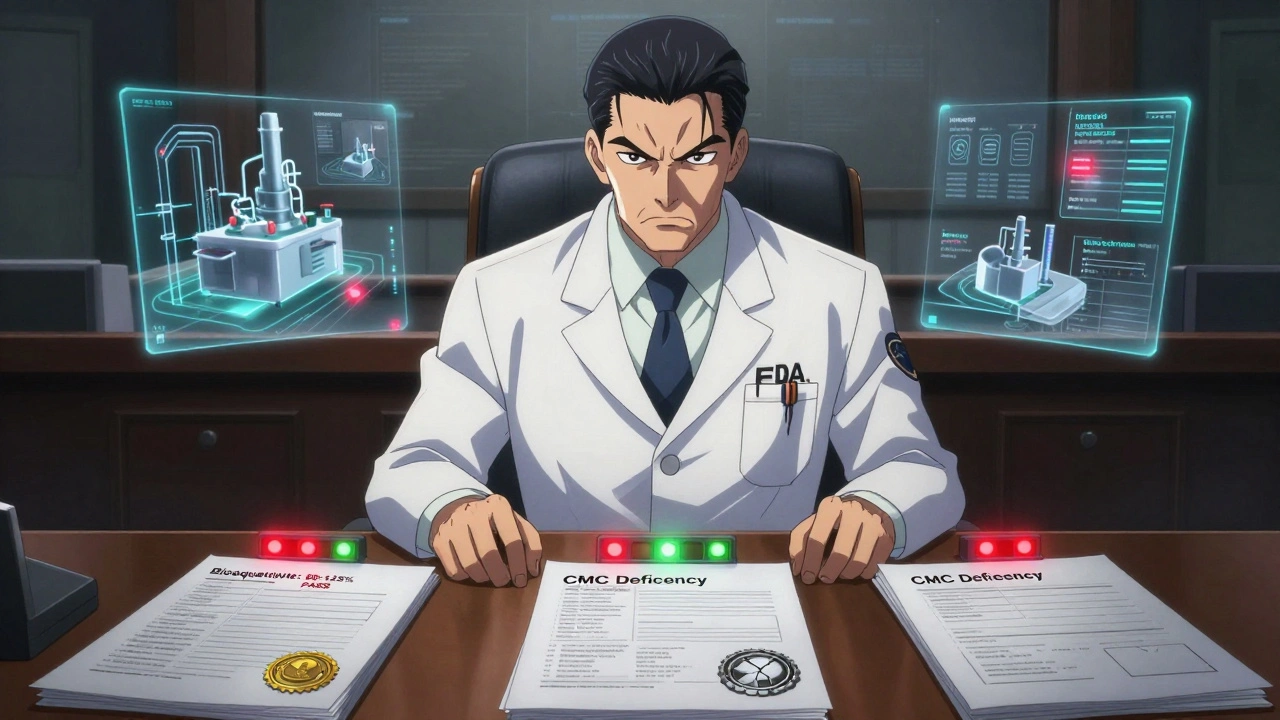
The FDA doesn’t just care about what’s in the pill - they care about how it’s made. The CMC section of the ANDA is often the most complex. It includes:- Details on the active pharmaceutical ingredient (API) source and synthesis
- Manufacturing process flowcharts and equipment specs
- Quality control tests for each batch (purity, dissolution, stability)
- Stability data showing the drug won’t degrade over time
- Packaging materials and labeling
All of this must follow Current Good Manufacturing Practices (cGMP). The FDA inspects every manufacturing site - whether it’s in the U.S., India, or China. If the facility fails inspection, the application is put on hold. In 2023, 22% of ANDA deficiencies were linked to manufacturing issues, according to the FDA’s Office of Generic Drugs.
Step 5: Format the Application in eCTD
The ANDA isn’t a paper form. It’s a digital dossier in a strict format called the electronic Common Technical Document (eCTD). This structure has five modules:- Module 1: Administrative info - company details, application type, fees.
- Module 2: Summaries - overview of quality, safety, bioequivalence.
- Module 3: Quality data - CMC details.
- Module 4: Nonclinical studies - rarely needed for generics unless there’s a new formulation.
- Module 5: Clinical data - bioequivalence study reports.
The eCTD format helps the FDA’s reviewers quickly find what they need. A poorly formatted submission gets flagged immediately. The FDA has 60 days to decide if the application is “filed” - meaning it’s complete enough to start review. If it’s incomplete, you get a Refuse to File letter. No review starts until you fix it.
Step 6: FDA Review and Inspection
Once filed, the clock starts. Under GDUFA IV (2023-2027), the FDA aims to complete its review of a complete ANDA within 10 months. That’s the standard. But not all applications are created equal.The review team includes scientists from pharmacology, chemistry, manufacturing, and labeling. They look for inconsistencies, missing data, or red flags. If they have questions, they send an Information Request (IR). You have 10 to 30 days to respond. Most applicants get at least one IR. One industry manager in Pittsburgh told me their metformin ER ANDA had two IRs - one for dissolution data, another for stability storage conditions.
Meanwhile, the FDA sends inspectors to your manufacturing site. If the plant hasn’t passed a cGMP inspection in the last two years, it’s a high priority. A failed inspection means delay - sometimes a year or more. In 2023, 32% of ANDA deficiencies were in the CMC section, mostly around inadequate process controls.
Step 7: Approval or Complete Response Letter (CRL)
At the end of the review, the FDA issues one of two outcomes:- Approval: Your generic can be sold. You get a letter and a listing in the Orange Book.
- Complete Response Letter (CRL): The application isn’t approved. The letter lists what’s missing or wrong.
About 75% of ANDAs get approved on the first try. That means 25% get a CRL. Common reasons: flawed bioequivalence design, inconsistent manufacturing data, or labeling that doesn’t match the RLD exactly. Some companies fix the issues and resubmit. Others abandon the project. One Reddit user shared that their nasal spray ANDA got three CRLs over 28 months - costing over $2.3 million.
Patents, Exclusivity, and Legal Hurdles
Even if your ANDA is perfect, you might not get to market right away. The brand-name drug might still be under patent or data exclusivity. That’s where Paragraph IV certifications come in.If you believe a patent is invalid or won’t be infringed, you can file a Paragraph IV certification. This triggers a 45-day window for the brand-name company to sue you for infringement. If they do, the FDA can’t approve your drug for 30 months - or until the court rules. This is where legal battles happen. The first company to file a successful Paragraph IV gets 180 days of market exclusivity. That’s worth hundreds of millions. The first generic of Humira made over $1.2 billion in its exclusivity period in 2023.
Why This Process Works
The ANDA system isn’t perfect, but it’s incredibly effective. Generics now make up 90% of all prescriptions filled in the U.S. - but only 23% of drug spending. That’s a $373 billion annual savings for the healthcare system.The FDA approves over 1,000 generics each year. Teva, Viatris, and Sandoz dominate the market, but more than 100 companies compete. The system works because it’s predictable. You know what you need to prove. You know the standards. You know the timeline.
That’s why experts like former FDA director Dr. Janet Woodcock call it a success. And why the FDA is investing in AI tools to speed up document review and launching initiatives for complex generics like inhalers and injectables.
What Doesn’t Work
The ANDA process isn’t designed for everything. Biologics - like insulin or rheumatoid arthritis drugs - are too complex to copy exactly. They have their own pathway: biosimilars. Complex generics - think topical creams, nasal sprays, or long-acting injectables - are harder to test for bioequivalence. The FDA is working on new guidance for 27 of these complex products.And while most generics are safe and effective, there have been rare cases of clinical differences - especially with narrow therapeutic index drugs. That’s why pharmacists and doctors still monitor patients closely when switching brands.
How Long Does It Really Take?
From idea to approval, the timeline looks like this:- 6-9 months: Design and run bioequivalence study
- 3-6 months: Develop manufacturing process and documentation
- 2-4 months: Assemble eCTD dossier
- 10 months: FDA review (after filing)
That’s 11 to 19 months minimum - not counting delays from CRLs, inspections, or patent lawsuits. Most companies spend $1-5 million per application. That’s a fraction of the $2.6 billion it costs to bring a new brand-name drug to market.
What Happens After Approval?
Once approved, the generic enters the market. The FDA continues to monitor it through adverse event reports, inspections, and post-market studies. If a safety issue arises - like a batch of pills with inconsistent dissolution - the FDA can pull it off the shelves. Generic manufacturers are held to the same standards as brand-name companies. There’s no second-class approval.And if another company comes along with an even cheaper version? They can enter the market too - unless you’re in your 180-day exclusivity window. That’s how competition drives prices down - sometimes by 90%.



Saket Modi
December 2, 2025 AT 05:30Shubham Pandey
December 3, 2025 AT 01:41Elizabeth Farrell
December 3, 2025 AT 19:08Sheryl Lynn
December 4, 2025 AT 05:25Paul Santos
December 5, 2025 AT 03:33Eddy Kimani
December 6, 2025 AT 22:55Victoria Graci
December 8, 2025 AT 13:20Saravanan Sathyanandha
December 9, 2025 AT 20:26Fern Marder
December 11, 2025 AT 11:24Chris Wallace
December 12, 2025 AT 11:27Sandi Allen
December 12, 2025 AT 15:04