
Repeat Colonoscopy: When to Get Another After Polyps Are Found

After a colonoscopy finds polyps, many people assume they’re in the clear. But that’s not true. Finding polyps doesn’t mean you’re done-it means your next colonoscopy matters even more. The timing of that follow-up can mean the difference between catching cancer early or missing it entirely. And the rules aren’t simple. They depend on how many polyps you had, how big they were, what they looked like under the microscope, and even how well your bowel was cleaned before the procedure.
Not All Polyps Are the Same
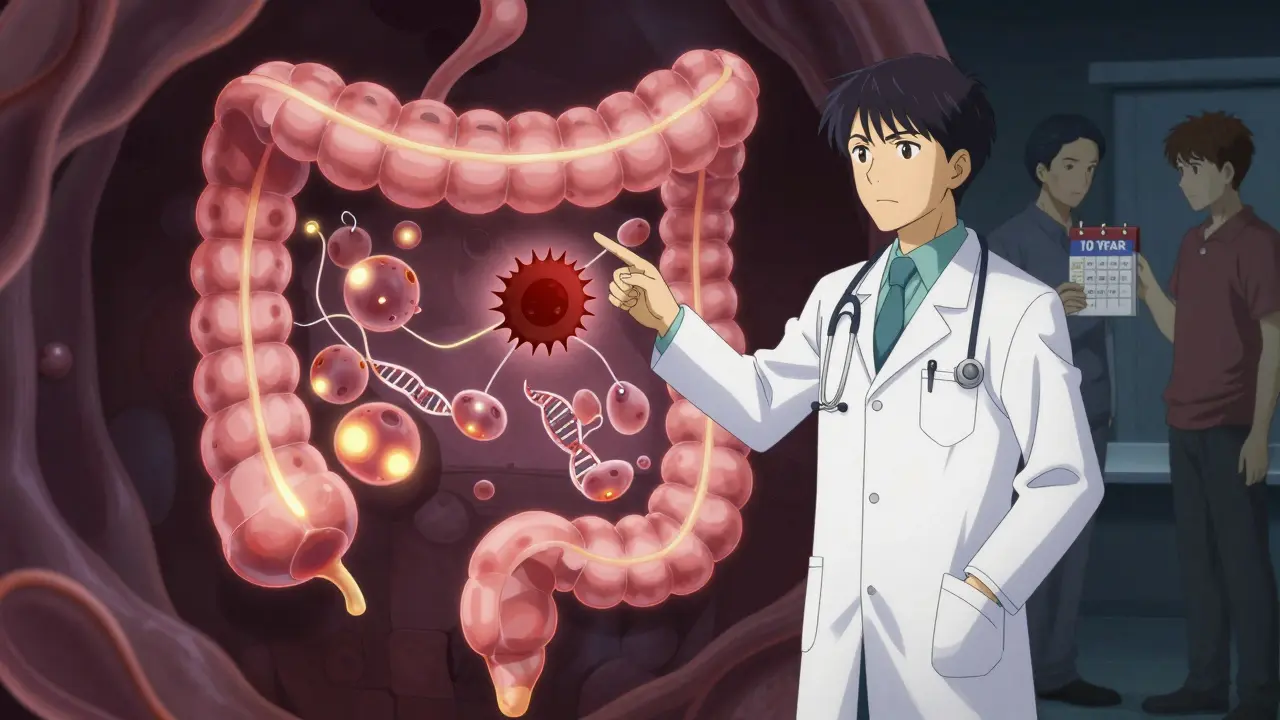
Not every polyp is dangerous. Some are harmless bumps, others are ticking time bombs. The two main types that matter for surveillance are adenomas and serrated polyps. Adenomas are the classic precancerous growths. If left alone, they can slowly turn into colorectal cancer over 10 to 15 years. Serrated polyps, especially sessile serrated lesions (SSLs), are trickier. They’re flatter, harder to spot, and can turn cancerous faster-sometimes in just 5 years.Hyperplastic polyps, on the other hand, are usually low risk-if they’re small and in the lower colon. But if one is larger than 10 mm, or if there’s any doubt about whether it’s really a hyperplastic polyp or a serrated one, doctors treat it like a warning sign.
What Determines Your Next Colonoscopy?
The 2020 guidelines from the U.S. Multi-Society Task Force on Colorectal Cancer are the gold standard in the U.S. They break down your next colonoscopy based on four key factors: number, size, type, and how completely it was removed.- 1 to 2 small adenomas (≤10 mm): Your next colonoscopy is due in 7 to 10 years. This was updated from the old 5-year rule because studies showed cancer risk was nearly identical to people with no polyps at all.
- 3 to 4 adenomas (all under 10 mm): You need a repeat colonoscopy in 3 to 5 years. The risk jumps here-not because the polyps are bigger, but because having more of them suggests your colon is more prone to growths.
- 5 or more adenomas: No matter the size, you’re back in 3 years. Multiple polyps mean your colon is actively producing them, and that needs close watching.
- Any adenoma ≥10 mm: Even if it’s just one, you’re due in 3 years. Size matters. Larger polyps have a higher chance of containing advanced changes.
- Villous features or high-grade dysplasia: These are red flags. If your pathologist sees these under the microscope, your next colonoscopy is in 3 years, no exceptions.
For serrated polyps, the rules are more nuanced. A single sessile serrated lesion under 10 mm? 5 to 10 years. Two to four? 3 to 5 years. Five or more? Back in 3 years. And if you had one that was removed in pieces (piecemeal resection), especially if it was over 20 mm, you need a follow-up in 6 months to make sure nothing was left behind.
Why the Confusion?
You might hear different advice from different doctors. That’s because guidelines vary by country. In Europe, some doctors still say 10+ years is fine for small adenomas. In the U.S., the 7-10 year window for low-risk cases is now standard-but many doctors still default to 5 years out of habit or fear of missing something.A 2023 study found only 52% of U.S. gastroenterologists correctly applied the 5-10 year rule for small serrated polyps. And in a Veterans Affairs hospital, just 18.6% of doctors followed the updated 7-10 year recommendation-even when they knew it was correct. Why? Fear. Legal risk. Uncertainty. Some doctors think, “Better safe than sorry,” even if the science says otherwise.
Patients get caught in the middle. Primary care providers, who often handle follow-up instructions, aren’t always trained in the details. One patient might get a 5-year reminder. Another, with the exact same polyps, gets told to come back in 10. It’s inconsistent. And that confusion leads to unnecessary procedures-or dangerous delays.
What About Bowel Prep and Missed Polyps?
A clean colon is critical. If your bowel prep was poor, your doctor might recommend a repeat colonoscopy in just 1 year-even if you only had a small adenoma. Why? Because a bad prep means they might have missed something. Studies show that when prep is inadequate, the chance of a missed cancer triples.Same goes for incomplete polyp removal. If a polyp was removed in pieces, especially if it was large, the risk of leftover tissue turning cancerous is real. That’s why a 6-month follow-up is required in those cases-to make sure the area is clean.
What’s New in 2025?
The field is moving beyond just counting polyps. Researchers are now testing blood and stool tests that look at DNA changes to predict cancer risk. Some trials are looking at methylation markers-chemical tags on DNA that signal abnormal cell growth. In the future, your surveillance interval might not just depend on what the doctor sees, but what the lab finds in your cells.The European Society of Gastrointestinal Endoscopy is updating its guidelines in late 2024, and they’re expected to tighten recommendations for certain serrated polyps. Meanwhile, tools like Polyp.app, used by over 12,000 clinicians, help doctors input your polyp details and instantly get the right interval. Still, these tools only work if the data is entered correctly.

What You Should Do
After your colonoscopy, get the results in writing. Don’t rely on memory or a phone call. Ask for the pathology report and the endoscopist’s summary. Then, ask: “Based on what you found, what’s my exact next colonoscopy date?” Don’t let them say “in a few years.” Get the number: 3 years, 5 years, or 10 years.If you had any high-risk features-large polyps, villous tissue, high-grade dysplasia, or multiple serrated polyps-follow up exactly as advised. Don’t skip it. Don’t delay. The goal isn’t to scare you. It’s to catch cancer before it starts.
And if you’re unsure what your next step is, take your report to a gastroenterologist. Don’t let your primary care doctor guess. This isn’t a routine checkup. It’s cancer prevention.
Why This Matters
Colorectal cancer is the second leading cause of cancer death in the U.S. But it’s also one of the most preventable-if you catch it early. Colonoscopy doesn’t just find cancer. It stops it. Every polyp removed is a cancer that never happened.Extending the interval for low-risk patients isn’t cutting corners. It’s smart medicine. It reduces unnecessary procedures, cuts costs, and avoids risks like bleeding or perforation from too many scopes. But only if you’re in the right group.
Getting the timing right isn’t just about following rules. It’s about matching the surveillance to your actual risk. And that’s something only the details of your polyps can tell you.




James Hilton
December 28, 2025 AT 12:59So let me get this straight-I get one tiny polyp and they want me back in 7 years? Meanwhile my dog gets more checkups than I do. 🐶
Mimi Bos
December 29, 2025 AT 09:43i got my results yesterday and i think i misread somethin? like was it 3 or 5 years? my doc was in a rush and i was still half-asleep from the prep. help??
Payton Daily
December 29, 2025 AT 15:11Let’s be real-this whole system is a capitalist circus. They don’t care if you live or die, they care if you keep coming back for more scopes. Colonoscopy is the new gym membership. Pay your dues, get your badge, feel like you’re doing something. But deep down? We’re all just meat sacks with faulty plumbing.
And don’t even get me started on the prep. That’s not medicine-that’s a purification ritual. You drink gallons of radioactive sludge, you sweat out your soul, and then they say, ‘Oh, your colon was kinda dirty.’ Like, congrats, you suffered for nothing.
Meanwhile, the guy who ate a whole pizza the night before gets a clean colon because his doc didn’t look too hard. That’s the real scandal. Not the polyps. The system.
We’re being gaslit by gastroenterology. And the worst part? We keep showing up. Because we’re scared. And fear sells.
Next time, I’m just gonna eat kale and pray. It’s cheaper. And less humiliating.
Bradly Draper
December 29, 2025 AT 18:26I just had my first colonoscopy last month and I was so nervous. Hearing all this made me feel a little better-knowing there’s a real plan, not just guesswork. Thanks for laying it out so clearly.
My doc said 10 years, and I actually wrote it down. I’m gonna keep that paper in my wallet.
Gran Badshah
December 30, 2025 AT 22:41Why do Americans make everything so complicated? In India, if you have polyp, doctor says come back in 5 years. Done. No charts. No tables. No apps. Just trust the doctor. You think your system is better? I think you overthink everything.
Ellen-Cathryn Nash
December 31, 2025 AT 23:30People need to stop treating their bodies like they’re on a subscription model. ‘Oh, I had a polyp, so now I pay the colon tax.’ No. You don’t owe the medical-industrial complex another $1,200 just because you ate one too many hot dogs in 2019.
And why are we letting doctors play God with timelines? If your prep was bad, maybe you should’ve been more responsible-not punished with a repeat scope. It’s not a grade, it’s your colon.
Stop being sheep. Ask for the pathology report. Demand clarity. Or don’t. But don’t act surprised when you’re stuck in a loop of fear and bills.
Samantha Hobbs
January 1, 2026 AT 06:45Wait so if I had 3 polyps but they were all under 10mm, I go back in 3-5 years? But if I had one big one, I go back in 3? So size matters more than quantity? That feels kinda backwards. Like, if you have three tiny bombs, shouldn’t that be worse than one big one? 🤔
Nicole Beasley
January 2, 2026 AT 23:21Just got my results and I have a sessile serrated lesion 😳 I didn’t even know what that was. Now I’m googling ‘can it turn cancer in 5 years’ at 2am. Someone please tell me I’m not gonna die. 🥺😭
sonam gupta
January 4, 2026 AT 04:30USA thinks it knows everything but in India we know how to live longer with less doctors and less tests. Your system is broken. Polyp? Eat turmeric. Drink warm water. Stop being scared. Your body is stronger than your fear.