
Apixaban vs Rivaroxaban vs Dabigatran: Key Side Effect Differences You Need to Know
DOAC Side Effect Comparison Tool
When doctors prescribe a blood thinner for atrial fibrillation or a blood clot, they don’t just pick one at random. Apixaban, rivaroxaban, and dabigatran all prevent strokes and clots-but they don’t act the same way in your body, and their side effects are not interchangeable. If you’ve been told you need a direct oral anticoagulant (DOAC), knowing the real differences between these three can help you avoid serious complications.
Why These Three Matter
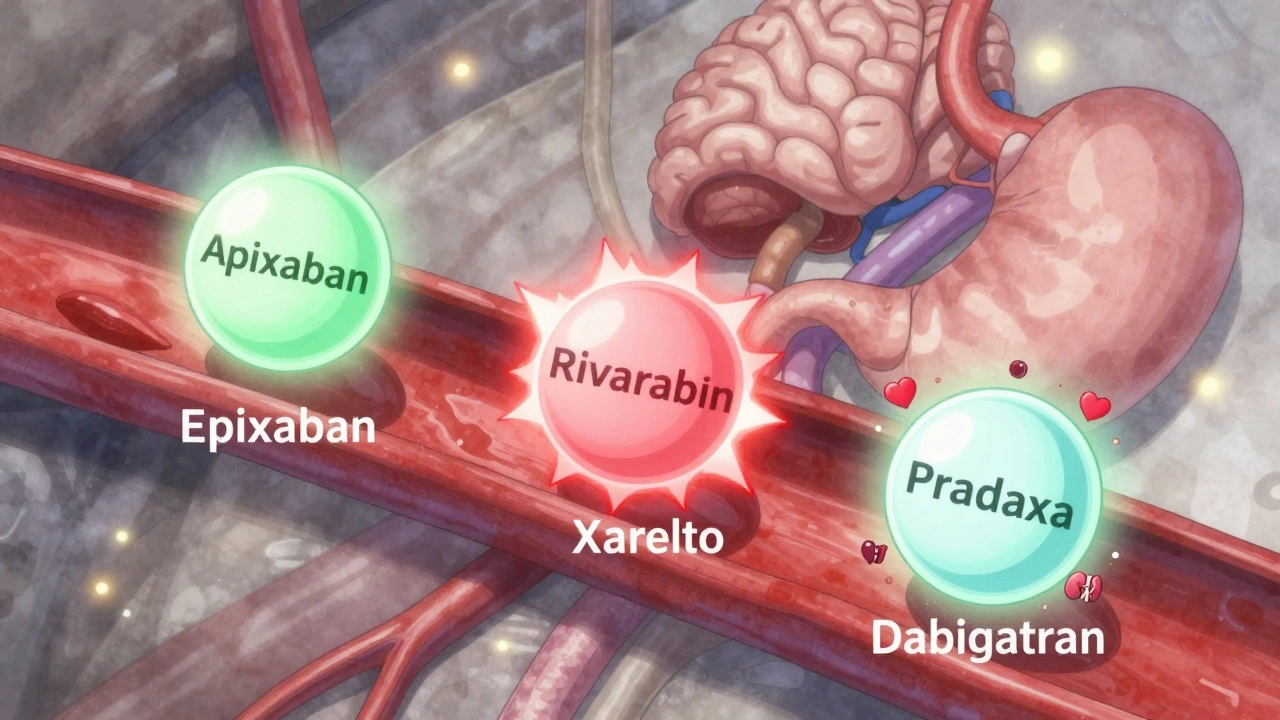
Apixaban (Eliquis), rivaroxaban (Xarelto), and dabigatran (Pradaxa) are the most commonly used DOACs in the U.S. They replaced warfarin for most patients because they don’t need constant blood tests and interact with fewer foods. But while they all thin the blood, they work differently. Dabigatran blocks thrombin (factor IIa). Apixaban and rivaroxaban block factor Xa. That small difference changes how your body reacts to them.GI Bleeding: The Biggest Real-World Risk
If you’ve had a stomach ulcer, gastritis, or even just regular heartburn, this matters a lot. Apixaban has the lowest risk of gastrointestinal bleeding among the three. A 2022 study in JAMA found that patients on rivaroxaban had nearly double the rate of GI bleeds compared to those on apixaban-35.2 events per 1,000 person-years versus 16.3. Dabigatran was close behind rivaroxaban. That’s not a small gap. It’s the difference between a 3.5% and 1.6% annual risk of bleeding in your stomach or intestines. Why? Dabigatran and rivaroxaban stay in the gut longer and irritate the lining. Apixaban is absorbed more efficiently and leaves the system faster. For someone over 70 with a history of ulcers, choosing apixaban over the others isn’t just a preference-it’s a safety decision.Major Bleeding: It’s Not Just About the Stomach
Major bleeding means bleeding that requires a hospital visit, transfusion, or causes a drop in hemoglobin. Rivaroxaban consistently shows higher rates here too. The same JAMA study found 39.7 major extracranial bleeds per 1,000 person-years with rivaroxaban versus just 18.5 with apixaban. That’s more than double. Dabigatran sits in the middle, slightly better than rivaroxaban but worse than apixaban. This isn’t theoretical. Real people in real clinics are ending up in the ER because of internal bleeding. One 78-year-old woman in Pittsburgh started on rivaroxaban for AFib and ended up with a bleeding ulcer after six months. Her doctor switched her to apixaban. She’s been fine for two years now.Intracranial Bleeding: The Most Dangerous Type
Bleeding in the brain is rare but deadly. All three DOACs are safer than warfarin here-but not equally so. The common belief is that all factor Xa inhibitors (apixaban and rivaroxaban) are the same. They’re not. A 2022 study found rivaroxaban had a lower rate of intracranial hemorrhage than apixaban. That’s counterintuitive, but it’s backed by data. Dabigatran, especially the 110 mg dose, also showed lower brain bleeding risk than rivaroxaban in earlier trials. So if you’re at high risk for falls-maybe you have balance issues, Parkinson’s, or live alone-your doctor might lean toward dabigatran or rivaroxaban over apixaban, even with its higher GI risk. It’s a trade-off. No perfect option.
Heart Attacks and Coronary Events: The Hidden Risk with Dabigatran
This one catches people off guard. Dabigatran has been linked to a higher risk of heart attacks and acute coronary syndrome. Multiple meta-analyses, including one published in PMC in 2014, found a 48% higher relative risk of heart attack with dabigatran compared to other DOACs. Why? The theory is that blocking thrombin might trigger inflammation in arteries, similar to a drug (ximelagatran) pulled from the market years ago for this exact reason. If you have coronary artery disease, angina, or a history of heart attack, dabigatran might not be the best choice. Apixaban and rivaroxaban don’t show this same signal. For someone with both AFib and blocked arteries, apixaban is often the safest pick.Dosing, Kidneys, and Daily Life
Dabigatran must be taken twice a day, no matter what. Apixaban too. Rivaroxaban is once daily for stroke prevention, which helps with adherence. But if you miss a dose of rivaroxaban, your protection drops faster than with apixaban because of its shorter half-life. Kidney function changes everything. Dabigatran is 80% cleared by the kidneys. If your creatinine clearance is below 30 mL/min, you can’t take the standard 150 mg dose. Apixaban and rivaroxaban are safer in mild kidney disease because they’re less dependent on kidney function. But if your kidneys are severely impaired (below 15 mL/min), none of them are ideal. Your doctor might switch you to warfarin or adjust the dose carefully.Who Gets Which Drug? Real-World Decisions
Here’s how most cardiologists decide today:- Apixaban is first-line for most patients-especially those over 75, with prior GI bleeding, kidney issues, or a history of heart disease. It’s the safest overall in real-world use.
- Rivaroxaban is chosen when once-daily dosing is critical for adherence. But avoid it if you’ve had a stomach bleed, are on NSAIDs like ibuprofen, or have uncontrolled high blood pressure.
- Dabigatran is rarely first choice anymore. It’s considered if someone has very poor kidney function (but still above 15 mL/min), can’t afford apixaban, or has a specific reason to avoid factor Xa inhibitors. It’s also used in younger patients with no heart disease history.

Cost and Accessibility
Brand-name Eliquis costs over $500 for a 30-day supply. But generic apixaban? Around $20-$30 with a GoodRx coupon. Rivaroxaban and dabigatran generics are similarly priced. Cost shouldn’t be the deciding factor. Choosing the wrong drug based on price could land you in the hospital.What If You’re Already on One?
If you’re on rivaroxaban or dabigatran and haven’t had bleeding or heart issues, don’t panic. But if you’ve had a GI bleed, unexplained bruising, or chest pain, talk to your doctor. A switch to apixaban could reduce your risk significantly. Never stop or change your dose without medical guidance. Stopping suddenly can cause clots.Future of DOACs
New studies are underway to see if genetics can predict who responds best to which drug. Some people metabolize these drugs faster or slower due to their DNA. In the next five years, we may see personalized DOAC selection-not based on averages, but on your biology. Until then, stick with the evidence: apixaban has the lowest risk of major bleeding, especially in the gut. Rivaroxaban carries higher bleeding risks but is easier to take. Dabigatran has the highest heart attack risk and needs careful kidney monitoring. Your blood thinner isn’t just a pill. It’s a tool. And like any tool, the right one depends on your body, your history, and your life.Which blood thinner has the least side effects?
Apixaban has the lowest risk of major bleeding, especially gastrointestinal bleeding, compared to rivaroxaban and dabigatran. It also carries a lower risk of fatal bleeding and is preferred in older adults and those with kidney issues. While no drug is side-effect-free, apixaban offers the best safety profile overall based on real-world data from multiple large studies.
Can I switch from rivaroxaban to apixaban?
Yes, switching is common and often recommended if you’ve had GI bleeding, are over 75, or have kidney problems. Your doctor will typically stop rivaroxaban and start apixaban the next day, with no overlap. No bridging with heparin is needed. Always do this under medical supervision-never switch on your own.
Why is dabigatran less commonly prescribed now?
Dabigatran’s use has dropped because of its higher risk of gastrointestinal bleeding and increased chance of heart attack compared to apixaban and rivaroxaban. It also requires twice-daily dosing and strict kidney function monitoring. While it’s still effective, newer evidence favors apixaban as the safer default option for most patients.
Do DOACs require regular blood tests like warfarin?
No. Unlike warfarin, DOACs like apixaban, rivaroxaban, and dabigatran don’t need routine INR blood tests. They have predictable effects and don’t interact much with diet or most medications. However, kidney and liver function tests are still checked once or twice a year to ensure the dose remains safe.
What should I avoid while taking these blood thinners?
Avoid NSAIDs like ibuprofen and naproxen-they increase bleeding risk. Use acetaminophen (Tylenol) instead for pain. Limit alcohol. Tell all your doctors you’re on a blood thinner before any surgery or dental work. Avoid herbal supplements like ginkgo, garlic, or fish oil in high doses without checking with your doctor.



Jane Quitain
December 6, 2025 AT 21:19apixaban is literally the only one i’d trust my grandma on 😅 i had an uncle on xarelto who ended up in the er with a GI bleed-now he’s on apixaban and hasn’t had a single scare. why risk it?
Sam Mathew Cheriyan
December 7, 2025 AT 13:56lol did you know the pharma companies paid the jama study authors? they just want you to buy eliquis because it’s profitable. dabigatran is fine if you’re not brainwashed by big pharma. also, who says bleeding is bad? maybe your body just needs to detox 😎
Ernie Blevins
December 9, 2025 AT 08:06apixaban has lower bleeding? sure. but did you check the mortality rates? nope. because they don’t publish that. also, how many of these people were on ibuprofen? nobody talks about that. this is all marketing. they just want you to switch so they can upsell.
David Brooks
December 10, 2025 AT 08:14OMG THIS IS SO IMPORTANT!! I was on rivaroxaban for 8 months and almost died from a nosebleed that wouldn’t stop. My cardiologist switched me to apixaban and I feel like a new person. You’re not just taking a pill-you’re choosing your next birthday. 🙌❤️
Sadie Nastor
December 10, 2025 AT 18:07i’ve been on apixaban for 3 years and honestly? best decision ever. no weird bruising, no stomach issues. just… life. also i use the mymeds app to remind me, it’s a lifesaver 🤍
Stacy here
December 12, 2025 AT 08:38let me tell you something they don’t want you to know: the FDA approved these drugs too fast. they’re all just chemical experiments with your life. and why does apixaban ‘win’? because it’s the most expensive. corporations control everything. even your blood. 💀
Kyle Flores
December 14, 2025 AT 04:56my dad’s on apixaban after a GI bleed on xarelto. he’s 82. no more ER visits. no more scary scans. just a simple pill twice a day. if you’re over 70, this isn’t theoretical-it’s survival. thank you for laying this out so clearly.
Olivia Hand
December 15, 2025 AT 18:39the dabigatran-heart-attack link is terrifying. i had a friend on it who had a silent MI at 64. no chest pain, just fatigue. they didn’t connect it until her cardiologist dug into the meta-analyses. never again. apixaban for life.
Desmond Khoo
December 17, 2025 AT 00:54once-daily is nice but i’d rather take two pills and not bleed out 😅 apixaban’s my guy. also, if you’re on this stuff, just stop taking ibuprofen. tylenol is fine. i learned the hard way.
Louis Llaine
December 18, 2025 AT 19:50so you’re telling me the only reason apixaban is popular is because it’s not as bad as the others? brilliant. we’re just picking the least worst option. congrats, medicine.
Kurt Russell
December 18, 2025 AT 22:07if you’re over 70, have any kidney issues, or have ever had a stomach ulcer-apixaban is your best friend. period. this isn’t opinion. this is data from 100k+ patients. stop overthinking it. your body will thank you.
Ryan Sullivan
December 19, 2025 AT 22:06the statistical superiority of apixaban in GI bleeding is statistically significant (p < 0.001), yet the absolute risk reduction is modest. one must consider the cost-benefit ratio, particularly in low-risk cohorts where the number needed to treat exceeds 100. Also, adherence metrics are confounded by dosing frequency. A nuanced approach is required.
Helen Maples
December 20, 2025 AT 05:41if you're on rivaroxaban and haven't bled yet, you're lucky-not safe. this isn't a game of chance. apixaban is the standard of care for a reason. stop arguing and talk to your doctor. your life isn't a debate thread.
Jennifer Anderson
December 20, 2025 AT 07:27my mom switched from dabigatran to apixaban last year-she said she finally felt like herself again. no more bloating, no more panic about every little bruise. thank you for this post. it helped us make a decision without fear.