
Decision Aids for Switching Medications: Risks and Benefits
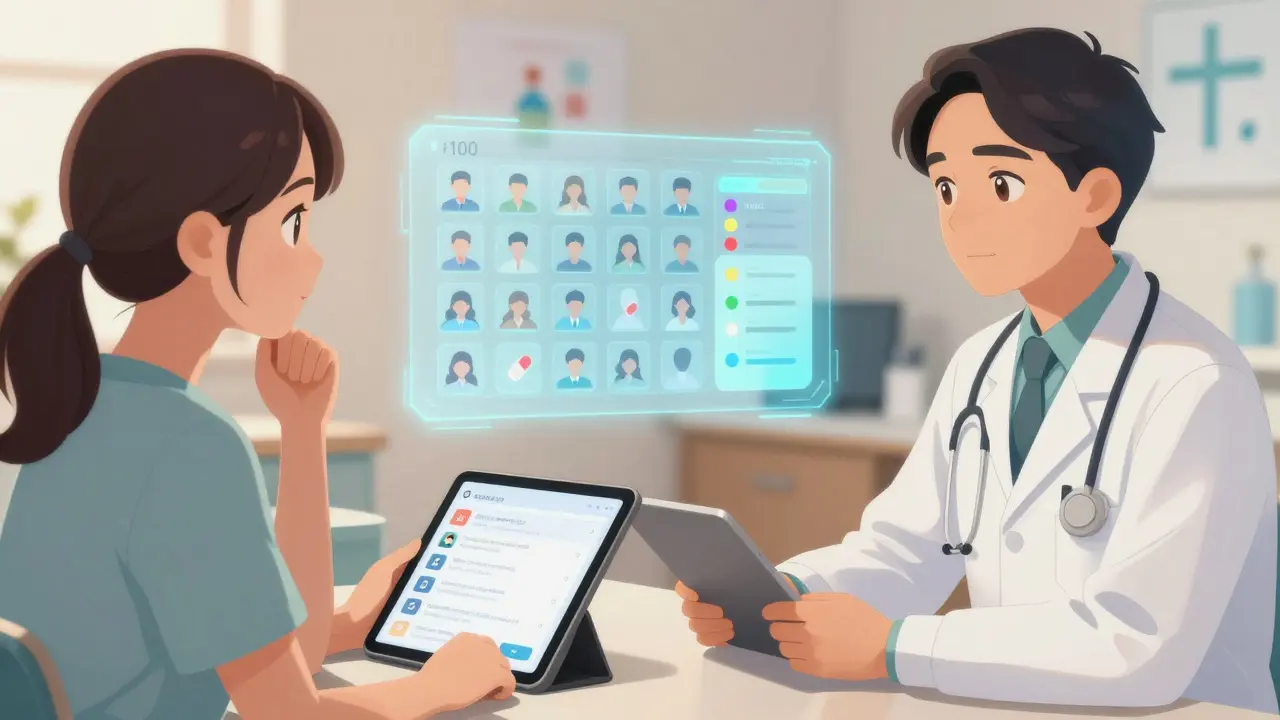
Medication Priority Calculator
What Matters Most to You?
This tool helps you identify which factors are most important when considering a medication switch. Based on your answers, you'll see your personal priority score for different treatment options.
1. Side Effects
How important is avoiding specific side effects to you?
2. Cost
How much does cost affect your decision?
3. Dosing Frequency
How important is taking medication once vs multiple times daily?
4. Effectiveness
How important is maximum effectiveness of the medication?
Personal Priority Summary
Understanding your priorities helps you make decisions that align with what matters most to you. When discussing medication switches with your doctor, you can use these insights to guide the conversation.
Switching medications isn’t just about swapping one pill for another. It’s a decision that can change how you feel every day - for better or worse. Many people stop taking their meds within the first year not because they’re noncompliant, but because they didn’t fully understand what they were getting into. That’s where decision aids come in. These aren’t fancy brochures or generic websites. They’re structured tools designed to help you and your doctor make a smart, personal choice when it’s time to change your treatment.
What Exactly Is a Medication Decision Aid?
A decision aid is a tool that lays out the real numbers behind switching medications. It doesn’t just say, "This drug works better." It shows you exactly how much better - and what you might lose in return. For example, instead of saying "Medication A reduces heart attack risk," a good decision aid says: "Out of 100 people like you, 10 will have a heart attack in five years without this drug. With it, that number drops to 8. But 30 of them will gain weight, and 5 will feel nauseous every day." These tools use visual aids like icon arrays - small pictures of 100 people, with colored dots showing who experiences side effects or benefits. They compare options side by side: "Medication B has a 15% chance of weight gain. Medication C has 30%. But Medication C costs $20 a month less." They also ask you questions: "How important is taking one pill a day vs. two?" "Is avoiding weight gain more important than preventing a stroke?" Your answers help guide the final choice. This isn’t about what the doctor thinks is best. It’s about what matters most to you.
Why Do People Struggle With Switching Medications?
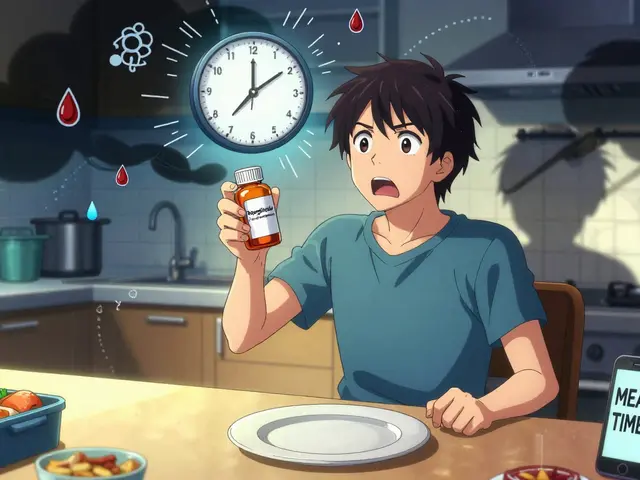
One in every two patients stops their medication within a year. Why? Because they weren’t prepared for the side effects. Maybe they read online that the new drug "has fewer side effects," but no one told them it could cause dizziness when they stand up. Or they were told, "This will help your blood sugar," but no one explained that it might make them lose 10 pounds - and they didn’t want to.
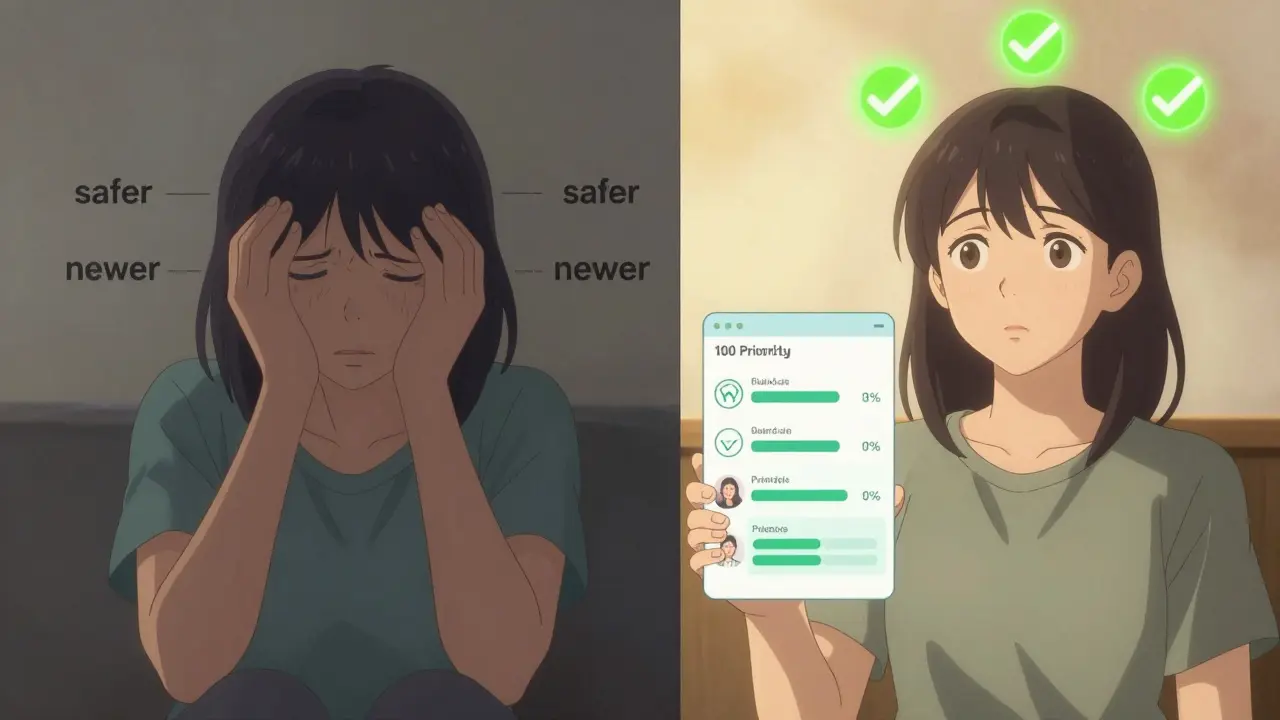
Traditional doctor visits rarely cover this. A 10-minute appointment leaves little room for deep discussion. Patients hear phrases like "it’s safer" or "it’s newer," but those don’t translate into personal understanding. A 2022 study in JAMA Internal Medicine found that 25-50% of medication discontinuations happen because patients felt their concerns about risks weren’t heard.
Decision aids fix this gap. They turn vague fears into concrete numbers. A veteran using the VA’s anticoagulant decision aid said: "Seeing 100 people with 3 bleeding events on the new drug vs. 8 on the old one made it real. I didn’t realize the difference was so small." These tools also reveal hidden trade-offs. One patient declined switching from metformin to a GLP-1 agonist after learning the new drug had a 12% chance of nausea - something they’d experienced before and couldn’t tolerate. Another chose a more expensive drug because it meant one daily pill instead of three. The decision aid didn’t push a choice. It made the trade-offs visible.
How Do They Compare to Regular Doctor Advice?
Standard counseling often relies on vague statements: "This is the best option," or "Most people do well with this." Decision aids replace guesswork with data. A 2022 review in Patient Education and Counseling found that patients using decision aids remembered 32% more about their options six months later than those who only got pamphlets.
They also reduce decision conflict - that uneasy feeling of "Did I make the right choice?" A study showed a 28% drop in this anxiety among users. That matters because people who feel confident in their choice are far more likely to stick with it.
But they’re not magic. In rushed clinics, doctors report that using these tools adds 7-12 minutes to each visit. A 2023 survey of 1,200 clinicians found 68% said workflow disruptions made them hesitant to use them. And if a patient is in crisis - say, a sudden drop in blood pressure - there’s no time for a decision aid. These tools are for planned, thoughtful switches, not emergencies.

Where Are They Used Today?
Decision aids are most common in places where choices are complex and outcomes are uncertain. The VA uses them heavily for mental health meds, anticoagulants, and diabetes drugs. The Mayo Clinic has a library of 15 condition-specific aids. The Ottawa Hospital Research Institute offers 42, available in 12 languages and designed to meet accessibility standards.
They’re built for digital use - web apps, patient portals, even smartphone tools. Some integrate directly into electronic health records like Epic. As of Q2 2024, Epic’s App Orchard lists 12 such tools ready for clinics to plug in.
But adoption varies. In VA facilities, 68% of providers use them for mental health meds. In general practice? Only 29%. Why? Training, time, and tech access. Not every patient has a smartphone. Not every clinic has staff trained to guide someone through the tool. A 2023 study found clinicians needed 3-5 uses before they felt comfortable leading the conversation around the aid.
What Do the Numbers Say?
Research is clear: decision aids work. A Cochrane review of 115 studies found patients using them scored 15-25% higher on knowledge tests. Their understanding of risks and benefits improved by 0.42 to 0.67 standard deviations - a big jump in medical education terms.
One standout example: switching antidepressants. A 2021 study in Diabetes Care showed that when patients used a decision aid to choose between GLP-1 agonists, 41% more ended up with a treatment that matched their personal priorities - like avoiding injections or minimizing GI side effects.
But there’s a catch. A 2021 BMJ commentary warned that some patients misinterpret numbers. One man thought "22% reduced risk" meant he’d avoid heart attacks entirely. He didn’t realize it meant going from 10% risk to 7.8%. That’s why tools now present risk in multiple formats - absolute numbers, relative changes, and visuals - to prevent misunderstanding.
Who Benefits Most?
These tools shine when there’s no single "right" answer. For example:
- Choosing between warfarin and DOACs for atrial fibrillation
- Switching antidepressants after one didn’t work
- Selecting diabetes meds when metformin isn’t enough
- Deciding whether to add a weight-loss drug to a diabetes regimen
They’re less helpful for patients with severe cognitive decline (MMSE score below 24) or in urgent situations. They also struggle if the evidence is shaky. If two drugs have almost no data comparing them, the aid can’t help much.
Still, feedback from users is mostly positive. A VA survey of 1,250 veterans found 78% felt more confident in their medication choices after using the tool. Reddit threads from r/Pharmacy show patients thanking the aids for helping them avoid side effects they feared - like weight gain, fatigue, or sexual dysfunction.
What’s Next?
The market for these tools is growing fast. It was worth $247.8 million in 2023 and is projected to grow over 14% annually through 2030. Medicare Advantage plans now require shared decision-making for high-cost drugs, which pushes clinics to adopt them.
New tech is making them smarter. Intermountain Healthcare launched an AI tool in early 2024 that personalizes risk visuals based on how you learn - whether you prefer numbers, charts, or stories. The FDA is also stepping in. Their 2024 draft guidance requires decision aids to be tested on diverse patient groups to ensure clarity.
But challenges remain. Only 38% of hospitals have funding to update these tools regularly. Medications change fast. A decision aid from 2022 might be outdated by 2024 if new side effects emerge. Experts warn that without a system to auto-update based on new FDA data, these tools could become misleading.
What Should You Do?
If you’re considering a switch:
- Ask your doctor: "Do you have a decision aid for this change?"
- Request it ahead of time - most are sent via email or portal 24-72 hours before your visit.
- Use it. Don’t just glance at it. Sit with the numbers. Think about what side effects matter most to you.
- Bring your answers to the appointment. Say: "I saw that this drug has a 20% chance of headaches. That’s something I can’t live with."
If you’re a patient and your clinic doesn’t offer one, ask why. If you’re a provider, start small. Pick one high-impact switch - like anticoagulants or diabetes meds - and try the VA’s free tool. The first time will feel slow. But after a few tries, it becomes part of the rhythm.
Medication switching isn’t about choosing the "best" drug. It’s about choosing the right one for you. Decision aids don’t make the choice for you. They just make sure you’re not flying blind.



steve sunio
February 10, 2026 AT 15:19lol so we're just gonna hand out fancy charts to people who can't read a prescription label? 🤡
my cousin took his blood pressure med wrong for 3 years 'cause he thought 'once daily' meant 'once every 3 days'. now you're gonna trust him with icon arrays? give me a break.
Suzette Smith
February 10, 2026 AT 21:41i love this idea but honestly? the real problem isn't the tools - it's that doctors don't have time to use them right.
my last doc just slid me a link and said 'read this' and bounced. no explanation, no chat. that's not shared decision-making, that's digital neglect.
Autumn Frankart
February 11, 2026 AT 19:38you know what's REALLY happening? Big Pharma is pushing these 'decision aids' so they can bury the real side effects under pretty graphics.
remember when they made those '100 people' charts for antidepressants? 30% weight gain? yeah, but they didn't show you the 12% who got suicidal ideation. that part's in the fine print. they want you to feel like you're in control... while they quietly profit.
also - why are these tools only available in English? what about the 40% of patients who speak spanish at home? this is just tech-washing exploitation.
Pat Mun
February 13, 2026 AT 07:04as someone who switched from metformin to a GLP-1 after using the VA's tool - i can't stress enough how much this changed my life.
before, i felt like i was just guessing. now? i saw the numbers. i realized i'd rather have nausea than gain 20 pounds. i saw the pill count, the cost, the injection schedule - and i picked what fit MY life, not some algorithm.
it wasn't magic. it was clarity. and honestly? i cried when i finally understood what my body was telling me. this isn't just medical - it's emotional labor made visible.
if you're skeptical, try it. sit with it. don't rush. the dots on those icons? they're not abstract. they're people. they're you.
and you deserve to know exactly what you're signing up for.
Sophia Nelson
February 15, 2026 AT 06:08why are we letting tech companies design our health decisions? Epic's App Orchard? are you kidding me? this is how surveillance capitalism gets into your blood pressure meds.
they track what you click, what you ignore, what you hesitate on - and sell it to insurers. next thing you know, your 'personalized' aid says 'avoid this drug because your zodiac sign predicts poor adherence.'
and don't get me started on the fact that these tools are only available if you have a smartphone, a wifi connection, and a social security number.
who decided this was healthcare? not me.
Skilken Awe
February 15, 2026 AT 22:47oh wow, a 15-25% knowledge increase? groundbreaking.
let me translate that: 85% of patients still don't understand what a 'relative risk reduction' means.
you think showing 100 little people with colored dots fixes the fact that 73% of Americans can't interpret a basic graph? please.
and let's not pretend these tools are 'patient-centered' - they're designed by pharma consultants who think 'icon arrays' are the same as 'informed consent.'
it's performative medicine. a PowerPoint with a heartbeat.
real patient care? that's a 45-minute conversation with a doctor who actually listens. not a 7-minute app session with a pop-up ad for a $1200 monthly drug.
andres az
February 17, 2026 AT 12:03you say decision aids reduce decision conflict? yeah, but at what cost?
they're turning complex medical choices into personality quizzes. 'how important is avoiding weight gain vs. avoiding stroke?'
that's not patient empowerment - that's behavioral nudging disguised as autonomy.
and the data? 2021 study in Diabetes Care? that was funded by Novo Nordisk. surprise.
the real issue isn't lack of information - it's lack of trust. and you can't fix trust with a color-coded pie chart.
Steve DESTIVELLE
February 18, 2026 AT 03:33we are in the age of hyper individualization of health where the body becomes a data point and the soul becomes a survey response
decision aids do not solve the crisis of alienation in medicine they merely aestheticize it
you give people numbers but you do not give them presence
you give them icons but you do not give them silence
the doctor who looks you in the eye and says i do not know what is best for you - that is the real decision aid
not a 12-minute app with a progress bar
not a chart of 100 dots
but the quiet space between two human beings where fear is not a variable to be optimized
and choice is not a selection from a menu
but an act of courage
and that cannot be coded
cannot be patented
cannot be sold on Epic's App Orchard
you want to heal? stop designing tools
start being present