
Warfarin and Vitamin K: How to Eat Consistently for Stable INR Levels
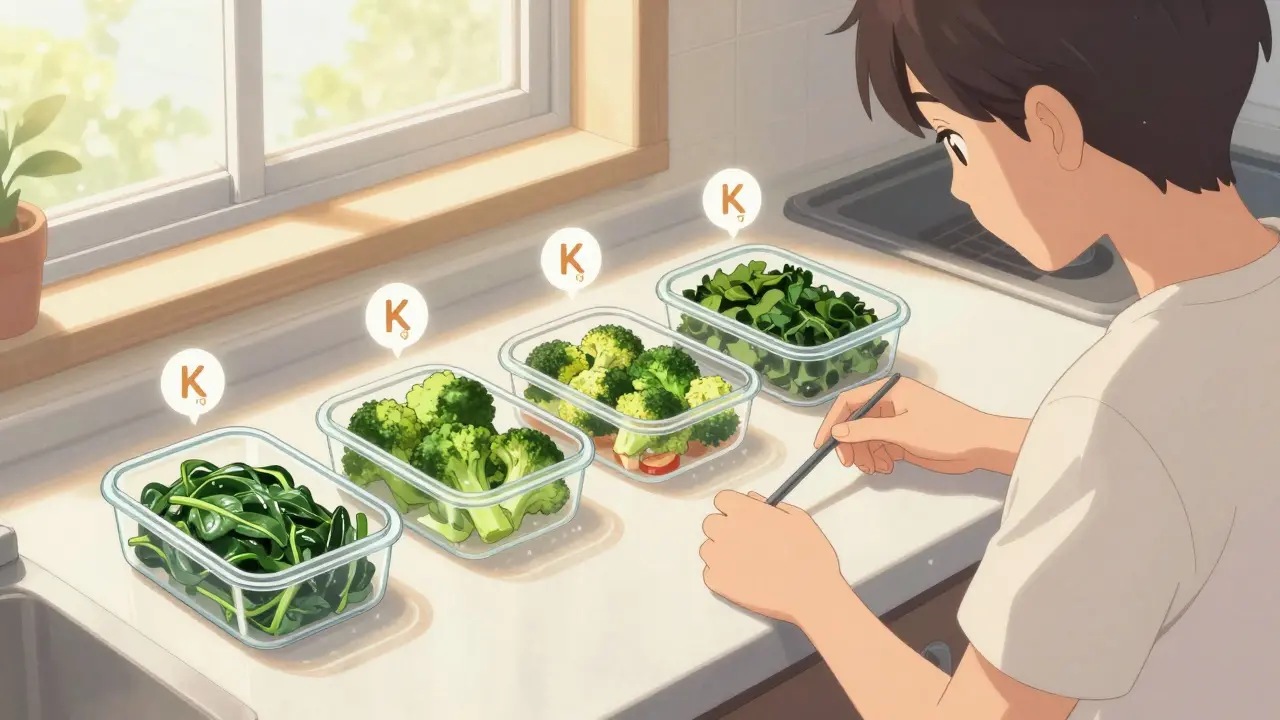
Vitamin K Consistency Calculator
Daily Vitamin K Tracker
Weekly Consistency Check
When you're on warfarin, your life doesn't revolve around pills-it revolves around consistency. Not just taking your dose on time, but eating the same amount of vitamin K every day. It’s not about cutting out spinach or kale. It’s about making sure you get roughly the same amount every week, so your INR doesn’t swing like a pendulum.
Why Vitamin K Matters More Than You Think
Warfarin works by blocking your body’s ability to recycle vitamin K, which is needed to make blood clotting factors. If you suddenly eat a huge amount of vitamin K-like a big bowl of cooked spinach or a kale smoothie-your body has enough active vitamin K to override warfarin’s effect. Your INR drops, and your risk of clots goes up. If you go days without any vitamin K-rich foods, your body runs low, and warfarin becomes too strong. Your INR spikes, and you risk dangerous bleeding. A 2019 study in Thrombosis and Haemostasis found that people with inconsistent vitamin K intake had more than twice the number of INR readings outside the safe range compared to those who ate steady amounts. That’s not just a number-it means more doctor visits, more blood tests, and more fear.The Old Myth: Avoid Green Vegetables
For years, patients were told to avoid leafy greens, broccoli, Brussels sprouts, and other vitamin K-heavy foods. That advice is outdated-and dangerous. The American College of Chest Physicians updated their guidelines in 2021 to say clearly: “Dietary vitamin K restriction is not recommended and may be harmful.” Why? Because when people restrict vitamin K, they don’t just lower their INR-they create instability. A 2020 statement from the American Heart Association found that patients who cut out greens had higher levels of undercarboxylated osteocalcin, a marker of vitamin K deficiency. That deficiency made their INR numbers even more unpredictable. You don’t need to stop eating kale. You need to eat it the same way, every time.What Counts as a “Consistent” Amount of Vitamin K?
The recommended daily intake for adults is 90-120 micrograms (µg), depending on gender. But you don’t need to hit that number exactly every day. You need to stay within about 20% of your usual amount. Here’s what that looks like in real food:- 1 cup cooked spinach = 889 µg
- 1 cup raw kale = 547 µg
- 1 cup cooked broccoli = 220 µg
- ½ cup cooked Brussels sprouts = 219 µg
- 1 egg = 20 µg
- 3 oz chicken breast = 2 µg
- 1 tablespoon olive oil = 10 µg
How to Make It Simple: The Weekly Plan
Forget daily tracking. Most people can’t do it. But most people can plan for the week. Here’s a real example that works for many patients:- Monday: ½ cup cooked broccoli at lunch
- Wednesday: 1 cup raw mixed greens in a salad (kale, spinach, arugula)
- Friday: ½ cup cooked Brussels sprouts with dinner
- Sunday: 1 boiled egg and 1 tbsp olive oil
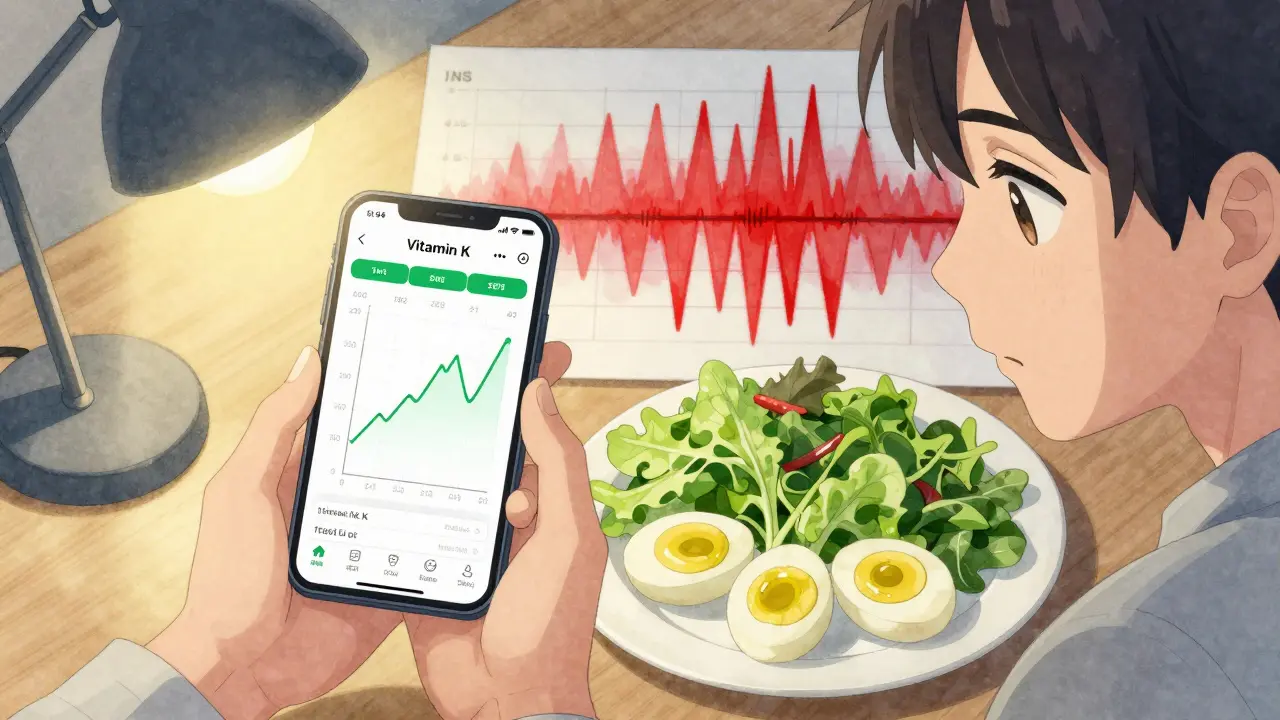
Tools That Actually Help
You don’t need to be a nutritionist. But you do need tools. - Food diary: For the first 4-6 weeks, write down what you eat. Use a notebook or your phone. Don’t guess. Write it down. - Measuring cups: Visual estimation is wrong 45% of the time, according to a 2022 study in the Journal of the Academy of Nutrition and Dietetics. A “handful” of spinach isn’t a cup. Use a measuring cup. - Apps: Apps like Warframate (iOS and Android) have databases with vitamin K values for over 1,200 foods. Scan barcodes, log meals, get alerts. It’s not perfect, but it’s better than guessing. - Pharmacist counseling: A 2021 Mayo Clinic study found that patients who got personalized dietary advice from a certified anticoagulation pharmacist hit 82% time in therapeutic range-compared to 63% with standard care. That’s a 19-point jump. That’s life-changing.Genetics Play a Role-But Not the Whole Story
Some people are naturally more sensitive to vitamin K because of their genes. Variants in the VKORC1 and CYP2C9 genes can make your body respond more strongly to small changes in vitamin K intake. If you’ve had trouble stabilizing your INR despite consistent eating, ask your doctor about genetic testing. But here’s the thing: even if you have a sensitive genotype, the solution isn’t to eat less vitamin K. It’s to eat it more predictably. One 2023 study showed that people with these variants needed to stay within ±10% of their usual intake-not ±25%-to stay stable. That’s tighter, but still doable with a simple weekly plan.What About Supplements?
Some patients are told to take vitamin K supplements to stabilize their INR. That’s not for everyone. A 2015 Blood study gave 150 µg of vitamin K daily to unstable patients. Their time in therapeutic range jumped from 58% to 66%. No extra bleeding. No side effects. But this only works if you take it every single day. Skip a day? Your INR swings again. Supplements are a tool for specific cases-not a replacement for dietary consistency. Talk to your doctor or pharmacist before starting one.
Real Stories: What Works
One Reddit user, u/WarfarinWarrior, shared how their INR was all over the place-sometimes 1.8, sometimes 5.2. They tried cutting out greens. It made things worse. Then their pharmacist gave them a simple sheet: “Eat 1 cup of mixed greens every Tuesday and Thursday.” No more guessing. No more fear. Their time in therapeutic range jumped from 45% to 78% in three months. Another patient, a 68-year-old woman from Pittsburgh, told her anticoagulation clinic she loved her morning smoothie with spinach. She was told to stop. She did-and her INR became even more erratic. When she was told to keep the smoothie but have it every day, her numbers stabilized. She now says, “I don’t feel like I’m on a diet. I just eat the same thing I always did. I just don’t skip days.”What to Do When Things Go Off Track
You ate a big salad on Saturday and forgot to log it. Your INR came back high. Now what? - Don’t panic. Don’t skip your next dose. - Call your anticoagulation clinic or pharmacist. They’ll adjust your dose based on your recent intake. - Go back to your weekly plan. Don’t try to “fix” it by eating less next week. That creates another swing. - Write down what happened. That’s how you learn.The Bottom Line
You don’t need to eat perfectly. You don’t need to be a nutrition expert. You just need to be predictable. - Eat vitamin K-rich foods regularly-but consistently. - Avoid big swings in intake from day to day. - Use measuring tools and apps to stay on track. - Talk to your pharmacist. They’re your best ally. - Don’t restrict. Don’t fear. Just balance. Stable INR means fewer hospital visits, fewer blood tests, and more peace of mind. It’s not about giving up your favorite foods. It’s about keeping your routine steady. That’s how you stay safe-and live well-on warfarin.Can I eat spinach if I’m on warfarin?
Yes, you can-and you should, but only if you eat it consistently. Eating spinach one day and avoiding it for a week will cause your INR to swing. The goal isn’t to avoid it, but to have about the same amount every week. One cup of cooked spinach a few times a week, at regular intervals, is fine.
Should I take a vitamin K supplement?
Only if your doctor or pharmacist recommends it. For most people, getting vitamin K from food is safer and more stable. Supplements can help if your INR is very unstable, but they must be taken daily without fail. Skipping even one day can cause your INR to drop suddenly.
How often should I check my INR?
When you first start warfarin or change your diet, you may need to check your INR weekly. Once your levels are stable and your diet is consistent, most people check every 4-6 weeks. But if you change your eating habits, start a new medication, or feel unwell, check sooner. Always tell your provider about any dietary changes.
What if I forget to eat my usual amount of vitamin K one day?
Don’t try to compensate the next day. If you skip your usual spinach, don’t eat two cups tomorrow. Just go back to your normal routine the day after. One off day won’t ruin your INR, but trying to “fix” it with a big meal will. Consistency over weeks matters more than perfection in a single day.
Does alcohol affect warfarin and vitamin K?
Yes. Heavy or binge drinking can increase your INR and raise bleeding risk. Even moderate drinking (more than 1-2 drinks per day) can interfere with how your liver processes warfarin. Stick to no more than one drink a day, and keep it consistent. If you don’t drink during the week, don’t have three on Friday. That pattern causes instability.
Can other medications interfere with vitamin K or warfarin?
Many can. Antibiotics, antifungals, aspirin, NSAIDs, and even some herbal supplements like garlic, ginkgo, and green tea can affect warfarin. Always check with your pharmacist before starting any new medication or supplement-even over-the-counter ones. They’ll know what to watch for.



Ajay Sangani
December 24, 2025 AT 01:36so like... if i eat spinach one day and then just eat rice for 3 days is that bad? i mean i dont even know how much is in a cup lol
claire davies
December 25, 2025 AT 05:03Oh my god, this is the most sensible thing I’ve read about warfarin in years. I’ve been on it for eight years and no one ever told me consistency > restriction. I used to avoid kale like it was poison until my pharmacist handed me a printed chart and said, ‘Just eat it every Tuesday.’ Now my INR’s stable and I’m actually enjoying my salads again. The real villain isn’t vitamin K-it’s the outdated fear-mongering. Thank you for writing this.
Bartholomew Henry Allen
December 26, 2025 AT 05:06Stop telling people to eat spinach. Americans are already too lazy to follow basic medical advice. If you want stable INR you need discipline not some weekly plan with mixed greens. Just take your pill and shut up about food.
Chris Buchanan
December 27, 2025 AT 10:28Bro this post is a godsend. I was about to quit warfarin because I thought I had to give up my morning smoothie. Now I’m making one every day at 7am like clockwork. My INR went from ‘rollercoaster’ to ‘elevator going up slowly’. You’re welcome, future me. 🙌
Wilton Holliday
December 27, 2025 AT 23:30Just wanted to say thank you for this. My grandma started this routine after reading something like this and her INR went from crazy to perfect in 2 months. She even made a little weekly calendar with stickers for her greens days. She’s 74 and now says she feels like she’s in control again 😊
Rosemary O'Shea
December 29, 2025 AT 00:43How quaint. A ‘weekly plan’? As if the average person can manage anything beyond ordering takeout and scrolling TikTok. You assume literacy, discipline, and access to measuring cups. Most patients are elderly, poor, or illiterate. This advice is beautiful in theory but a luxury for the privileged. You’re not helping-you’re just making them feel guilty for being human.
Diana Alime
December 30, 2025 AT 05:22i read this whole thing and my brain just said ‘so… eat the same thing every day? ok cool’
Pankaj Chaudhary IPS
December 31, 2025 AT 03:51This is a masterclass in patient-centered care. The integration of clinical evidence with practical behavioral design is exemplary. The emphasis on consistency over restriction aligns with global guidelines from WHO and ACCP. I commend the author for translating complex pharmacology into an actionable, culturally neutral framework. This should be distributed to all anticoagulation clinics in India and beyond.
Bhargav Patel
December 31, 2025 AT 13:47There is a deeper philosophical layer here, one that transcends warfarin and vitamin K. We live in an age of optimization, where every variable must be measured, tracked, and controlled. Yet the real wisdom lies not in perfection, but in rhythm. The human body, like the seasons, does not demand flawless precision-it responds to harmony. To eat the same amount of spinach on Tuesday and Thursday is not a medical protocol-it is a quiet act of trust. Trust in your body’s ability to adapt. Trust in the steadiness of routine. Trust that stability is not found in extremes, but in the gentle return to what is familiar. The pill is only half the medicine. The other half is the choice, every week, to come back to the same plate, the same rhythm, the same peace.
Raja P
January 2, 2026 AT 00:04my mom’s on warfarin and she’s been doing this for months now. she just eats her 1 cup of kale on tues/thurs and calls it good. no apps, no measuring cups, just remembers to eat it. her inr’s been solid for 6 months. sometimes simple works better than complicated.
Joseph Manuel
January 3, 2026 AT 04:55The study cited from Thrombosis and Haemostasis (2019) has a significant selection bias. The cohort was predominantly Caucasian, middle-class, and literate. The generalizability to populations with lower health literacy or limited access to fresh produce is negligible. Furthermore, the 2021 Mayo Clinic study on pharmacist counseling had a dropout rate of 37%. This is not a solution-it’s a privilege.
Adarsh Dubey
January 3, 2026 AT 15:34Just wanted to add-alcohol consistency matters too. I used to drink 3 beers on weekends and none during the week. My INR would spike every Monday. Now I have one beer every Friday. No more surprises. Same with vitamin K. Same with alcohol. Same with sleep. Same with stress. It’s all rhythm. Not perfection. Just rhythm.