
Hypothyroidism and Statins: How Thyroid Status Increases Myopathy Risk

Hypothyroidism & Statin Myopathy Risk Calculator
0.5
4.0
7.0
10.0
20.0
Your Risk Assessment
Loading...
Important: This calculator estimates relative risk based on published clinical studies. Individual risk factors may vary. Always consult your physician for medical decisions.
What this means:
- High Risk (Red) - TSH > 10.0 mIU/L or high-dose simvastatin/atorvastatin: Requires immediate thyroid optimization before statin therapy
- Medium Risk (Yellow) - TSH 7.0-10.0 mIU/L or moderate-dose lipophilic statins: Consider switching to rosuvastatin/pravastatin
- Low Risk (Green) - TSH < 7.0 mIU/L with hydrophilic statins: Generally safe with monitoring
If you’re on statins and have hypothyroidism, your risk of muscle damage isn’t just higher-it’s significantly higher. This isn’t a rare edge case. It’s a well-documented, clinically critical interaction that can lead to serious complications, including rhabdomyolysis, a life-threatening condition where muscle tissue breaks down and floods the bloodstream with toxins. Many patients and even some doctors miss this connection because the symptoms-muscle aches, weakness, fatigue-look like ordinary statin side effects. But when hypothyroidism is involved, the game changes.
Why Hypothyroidism Makes Statins More Dangerous
Statins work by blocking an enzyme your liver uses to make cholesterol. But they also interfere with coenzyme Q10, a compound your muscles need for energy. In healthy people, this is usually manageable. But in someone with hypothyroidism, the problem multiplies. Hypothyroidism slows down your metabolism in every way. Your liver doesn’t clear drugs as efficiently. The enzymes that break down statins-especially CYP3A4-work at half speed. That means more of the drug stays in your bloodstream. Studies show plasma levels of simvastatin and atorvastatin can rise by 30% to 50% in untreated hypothyroid patients. That’s not a small increase. It’s enough to push you over the edge into muscle injury. At the same time, low thyroid hormone levels damage your muscle cells’ energy factories-mitochondria. Your muscles are already running on low fuel. Then you add a statin, which cuts off another 25% to 50% of coenzyme Q10. The result? Muscle cells start dying. That’s when creatine kinase (CK), a muscle enzyme, leaks into your blood. Levels above 1,000 U/L signal trouble. Above 5,000 U/L? That’s a red flag. Above 10,000 U/L? You’re in danger of kidney failure.Who’s at the Highest Risk?
Not all hypothyroid patients face the same level of danger. Risk spikes when your TSH (thyroid-stimulating hormone) is above 4.0 mIU/L. But it gets much worse above 7.0, and especially above 10.0. A 2019 study of over 12,000 people found those with TSH above 10 had more than four times the risk of statin-induced myopathy compared to those with normal thyroid function. Even subclinical hypothyroidism-where TSH is between 4.5 and 10-raises your risk by more than double. That’s not just a statistical blip. It’s a real, measurable danger. And it’s often ignored because patients feel “fine.” Fatigue, muscle soreness, brain fog? They chalk it up to aging, stress, or being out of shape. But if you’re on a statin and your TSH is creeping up, those symptoms could be the first warning signs of something serious.Not All Statins Are Created Equal
If you have hypothyroidism, the type of statin you take matters just as much as the dose. Lipophilic statins-like simvastatin, lovastatin, and atorvastatin-cross cell membranes easily, including muscle cells. That makes them more likely to cause damage in people with compromised metabolism. Simvastatin at 40 mg or higher is especially risky. One analysis found 12.7% of hypothyroid patients on this dose developed myopathy, compared to just 2.1% of those with normal thyroid function. That’s a sixfold increase. For that reason, the American College of Cardiology now advises against high-dose simvastatin in hypothyroid patients. Hydrophilic statins-pravastatin and rosuvastatin-are safer. They don’t penetrate muscle tissue as easily. Pravastatin has the lowest risk profile, with only 1.3% myopathy incidence in hypothyroid patients. Rosuvastatin at 10-20 mg/day carries just a 1.4-fold increased risk, compared to 3.2-fold for atorvastatin. For patients with hypothyroidism, rosuvastatin is now the first-line choice in most guidelines.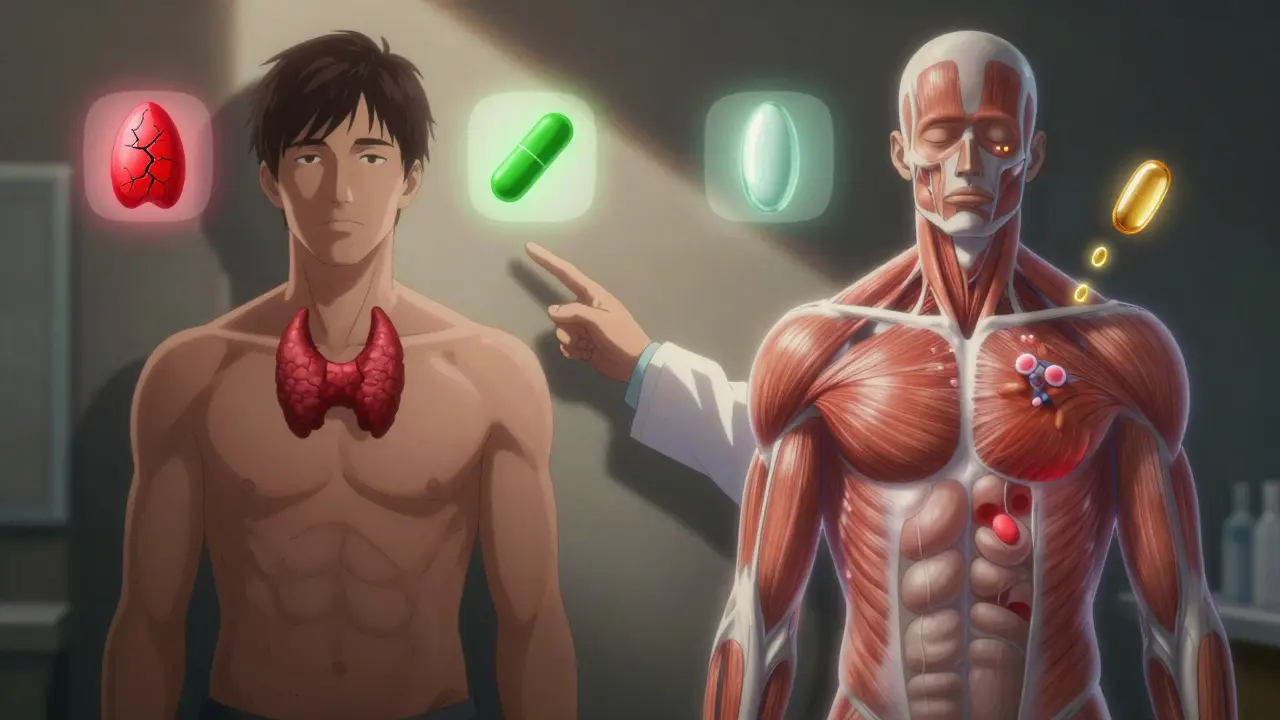
What Doctors Should Do Before Prescribing Statins
The standard of care has changed. The American Thyroid Association, the Endocrine Society, and the American College of Cardiology all agree: check your thyroid before starting a statin. If you’re being evaluated for high cholesterol and have symptoms like fatigue, weight gain, cold intolerance, or dry skin, get a TSH and free T4 test. Don’t assume you’re fine just because you’re on levothyroxine. Many patients are underdosed. TSH above 4.0 isn’t normal-it’s a signal to adjust medication. If your TSH is high, optimize your thyroid hormone first. Don’t start the statin until your TSH is between 0.5 and 3.0 mIU/L. This isn’t just a recommendation-it’s a proven way to reduce myopathy risk by 78%, according to Dr. Paul W. Ladenson of Johns Hopkins. Once your thyroid is stable, you can safely start a statin, often at a lower dose.Monitoring and What to Watch For
Once you’re on a statin, you need more than just a yearly checkup. Baseline CK levels should be checked before starting. Repeat the test at three months, and again if you develop new muscle pain, weakness, or dark urine (a sign of myoglobin release). If your CK rises above 10 times the upper limit of normal-or above 5 times with symptoms-you should stop the statin immediately. Don’t wait. Don’t “see how it goes.” Rhabdomyolysis can lead to kidney failure and death. One 2023 case report described a woman whose CK hit 28,500 U/L after continuing simvastatin while her TSH soared to 22.4. She needed dialysis. Even if your CK is only mildly elevated, persistent muscle pain shouldn’t be ignored. In hypothyroid patients, symptoms often appear at lower CK levels than in others. That’s because their muscles are already stressed. A CK of 1,500 U/L with muscle aches in a hypothyroid patient is more concerning than a CK of 3,000 U/L in someone with normal thyroid function.
What Patients Can Do
If you have hypothyroidism and are on a statin, here’s what you need to do:- Get your TSH checked every 6-12 months, or every 3 months if your dose changed recently.
- Report any new muscle pain, cramps, or weakness-even if it’s mild.
- Ask your doctor if your statin is the safest option for you. If you’re on simvastatin or atorvastatin, consider switching to rosuvastatin or pravastatin.
- Ask about CoQ10 supplementation. A 2020 trial showed 200 mg/day reduced muscle pain by over 50% in hypothyroid statin users. It’s not FDA-approved for this use, but it’s low-risk and often helpful.
- Don’t stop your statin without talking to your doctor. Many patients quit because of muscle pain, only to later find out their thyroid was under-treated. With proper management, 85-90% of hypothyroid patients can stay on statins safely.




Siobhan K.
December 20, 2025 AT 21:29So let me get this straight: we’re telling people with hypothyroidism to avoid statins unless they’re on rosuvastatin, but half the doctors still prescribe simvastatin like it’s 2008? And then wonder why patients show up with CK levels through the roof? This isn’t rocket science-it’s basic pharmacokinetics. Why is this still not standard protocol everywhere?
Brian Furnell
December 21, 2025 AT 02:26From a clinical pharmacology standpoint, the CYP3A4 enzyme suppression in hypothyroid states is well-documented; however, the magnitude of statin accumulation is highly variable depending on genetic polymorphisms in SLCO1B1 and ABCG2 transporters-factors rarely assessed in routine practice. Additionally, mitochondrial dysfunction secondary to low T3 directly impairs fatty acid β-oxidation, compounding statin-induced CoQ10 depletion. This is not merely an interaction-it’s a metabolic cascade.
Cara C
December 22, 2025 AT 06:41I’ve seen this so many times in my practice. Patients come in saying, ‘I can’t walk up the stairs,’ and we assume it’s statins. But when we check TSH-boom, it’s 14. Fix the thyroid, and half the symptoms disappear. No need to stop the statin. Just treat the root cause. Why is this still so hard to communicate?
Stacey Smith
December 23, 2025 AT 14:27Another reason to stop letting foreigners run our healthcare. We’re overmedicating people who don’t even need statins in the first place. If you’re tired and fat, maybe you’re just lazy. Stop blaming the drugs.
Teya Derksen Friesen
December 25, 2025 AT 10:05It is imperative to underscore the clinical significance of thyroid hormone optimization prior to the initiation of lipid-lowering agents. The data presented herein are robust and align with contemporary endocrine guidelines, which emphasize the necessity of achieving euthyroid status prior to statin therapy in order to mitigate the risk of myopathy and its attendant complications.
Jason Silva
December 27, 2025 AT 01:28LOL they don't want you to know this. Big Pharma doesn't want you to know that thyroid meds + statins = $$$ for them. CoQ10 is FREE and they don't sell it. The FDA is in on it. 100% controlled by the system. 😈💊
mukesh matav
December 28, 2025 AT 10:38Interesting. In India, we rarely test TSH before prescribing statins. Many patients are on simvastatin 40 mg without any thyroid screening. We need more awareness here.
Theo Newbold
December 28, 2025 AT 21:09Let’s be real. The entire premise is built on cherry-picked studies. The 2019 study had a 12,000-person cohort but didn’t control for age, BMI, or concomitant metformin use. And CoQ10? A placebo-controlled trial showed no benefit beyond 10%. This is fear-mongering dressed up as medicine.
Michael Ochieng
December 29, 2025 AT 22:12I’m from Kenya and we don’t even have routine thyroid testing here. But I’ve seen patients from the diaspora come back with these guidelines and change their doctors’ minds. It’s crazy how much difference a simple TSH test can make. This info needs to go global.
Dan Adkins
December 30, 2025 AT 05:01While the clinical observations presented are empirically valid, the absence of longitudinal data regarding the long-term cardiovascular outcomes of hypothyroid patients on hydrophilic statins constitutes a significant epistemological gap in the current literature. Furthermore, the assertion that CoQ10 supplementation confers therapeutic benefit lacks sufficient mechanistic elucidation within the context of mitochondrial bioenergetics in human skeletal muscle.