
Multiple Sclerosis: How Neurological Deterioration Happens and What Disease-Modifying Therapies Can (and Can’t) Do
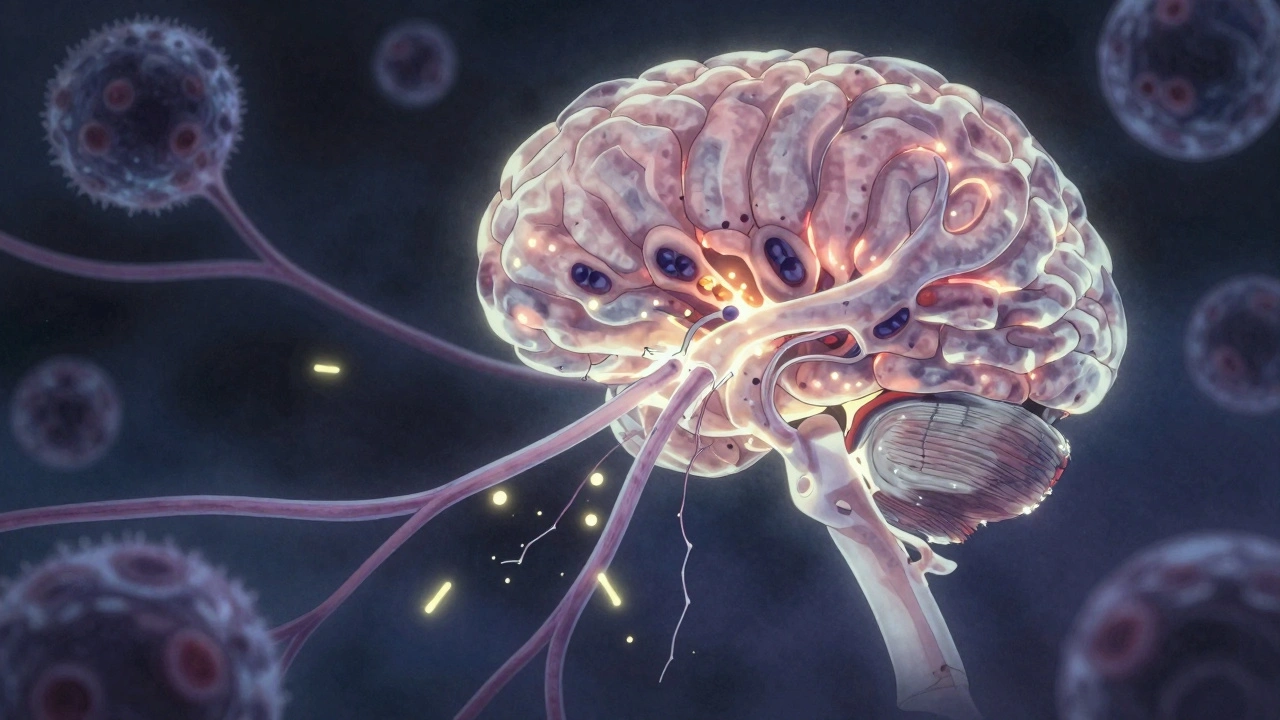
When someone is diagnosed with multiple sclerosis, the fear isn’t just about fatigue or numbness-it’s about what comes next. Will they lose the ability to walk? Will their hands stop working? Will the brain stop sending signals to the body? The truth is, MS doesn’t just flare up and fade away. Over time, it quietly breaks down the wiring inside the brain and spinal cord. And that breakdown is permanent.
What Actually Goes Wrong in Multiple Sclerosis?
Multiple sclerosis isn’t just an inflammation problem. It starts with the immune system attacking the myelin sheath-the fatty coating that wraps around nerve fibers in the central nervous system. Think of myelin like the insulation on an electrical wire. When it’s stripped away, signals from the brain get scrambled or blocked. That’s why people with MS experience vision problems, muscle weakness, or loss of balance during a relapse.
But here’s the critical part: the body can repair some of that damage. New myelin can form, and nerves can reroute signals. That’s why many people recover after a flare-up. The real danger isn’t the inflammation itself-it’s what happens after. When myelin is stripped away repeatedly, the nerve fiber underneath-the axon-starts to degenerate. And once an axon dies, it doesn’t grow back.
Research shows that up to 50% of demyelinated axons in chronic MS lesions show signs of damage: missing mitochondria, broken neurofilaments, and reduced organelles. These are the power sources and structural supports of the nerve. Without them, the axon can’t function, and eventually, it dies. That’s not reversible. That’s not fixable with steroids or anti-inflammatories. That’s why people with MS slowly lose function over years-even when their MRIs show no new lesions.
Why Progressive MS Doesn’t Respond to Standard Treatments
About 85% of people with MS are initially diagnosed with relapsing-remitting MS (RRMS). They have clear flare-ups followed by periods of recovery. For these patients, disease-modifying therapies (DMTs) work well. Drugs like interferons, glatiramer acetate, fingolimod, and ocrelizumab reduce relapses by 30-50%. They target the immune cells that attack myelin. They’re effective because the problem is still mostly outside the brain-immune cells crossing the blood-brain barrier and causing inflammation.
But after 10 to 15 years, about 40% of RRMS patients transition to secondary progressive MS (SPMS). Now, the flares become less frequent, but the decline continues. Walking gets harder. Memory fades. Bladder control worsens. And MRI scans? They show fewer new lesions. The inflammation has moved inward. The immune system is now active inside the brain and spinal cord, with B cells forming clusters near the meninges-the protective layers around the brain. These clusters act like mini-factories, pumping out harmful chemicals that slowly kill neurons and axons.
And here’s the brutal reality: none of the 21 FDA-approved DMTs were designed to stop this kind of damage. They’re built to fight inflammation. They don’t protect axons. They don’t repair myelin. They don’t replace dead nerve cells. That’s why patients with SPMS or primary progressive MS (PPMS) often see no benefit from these drugs-even the most powerful ones.
The Hidden Driver of Disability: Axonal Loss and Brain Atrophy
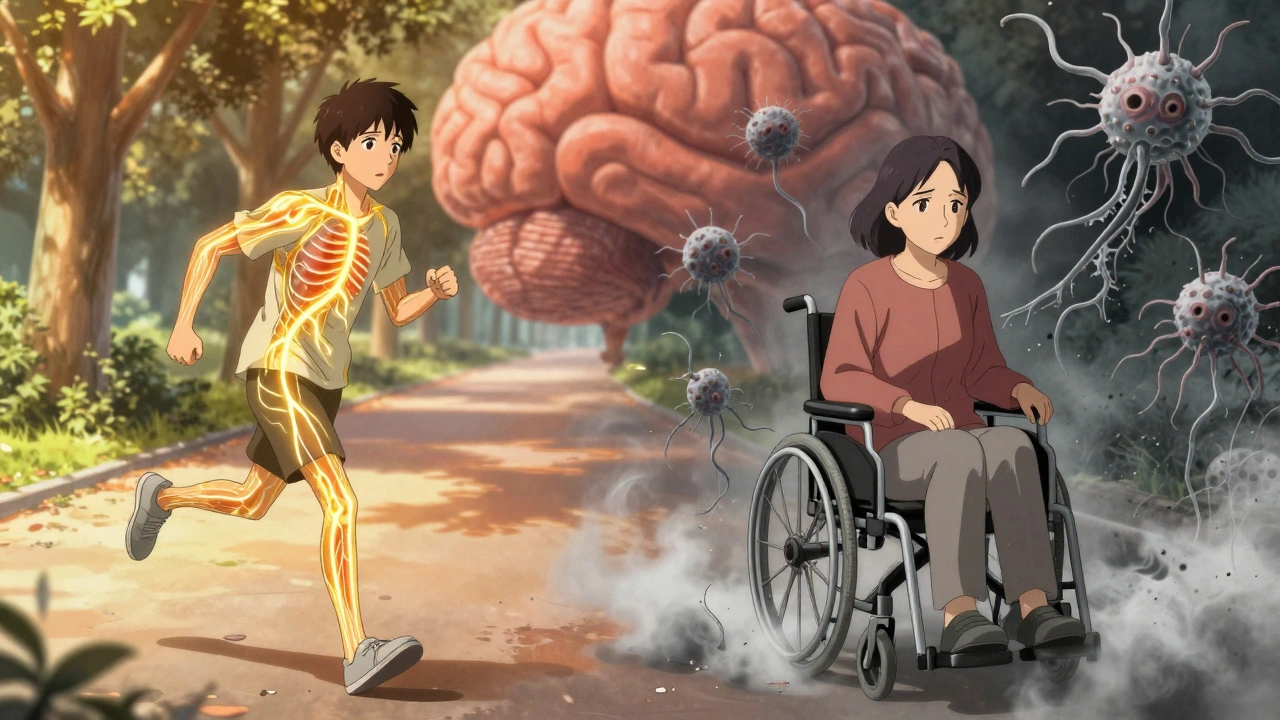
The most accurate predictor of long-term disability in MS isn’t the number of lesions on an MRI. It’s brain atrophy-the shrinking of brain tissue over time. Studies show that gray matter atrophy (the areas where nerve cell bodies live) correlates more strongly with functional decline than white matter lesions. People with faster gray matter loss are more likely to lose walking ability, have trouble with fine motor skills, or develop cognitive issues.
Why does this happen? One reason is chronic demyelination. Without myelin, axons can’t conduct signals efficiently. They burn through energy trying to transmit impulses. This leads to mitochondrial failure-the nerve’s power grid crashes. Sodium channels on the axon membrane also break down. These channels are essential for sending electrical signals. When they fail, even healthy axons stop working.
Microglia-the brain’s immune cells-also go haywire. In progressive MS, they become overactive and start chewing away at synapses and axons, even in areas that look normal on MRI. This is called “normal-appearing white matter” damage. It’s invisible on standard scans but measurable with advanced techniques like magnetization transfer ratio (MTR). And it’s happening long before symptoms appear.
What’s Being Done to Stop the Decline?
Scientists know now that MS isn’t just an autoimmune disease-it’s a neurodegenerative one too. That’s why the focus is shifting from just suppressing inflammation to protecting nerves.
There are currently 17 active clinical trials targeting progressive MS. Some are testing drugs that block sodium channels to prevent energy overload in axons. Others aim to boost mitochondrial function-helping nerves produce more energy. One promising approach involves remyelination therapies. Drugs like opicinumab and clemastine are being tested to stimulate the brain’s own stem cells to rebuild myelin.
There’s also research into blocking proteins that prevent nerve regeneration. Three proteins-Nogo, MAG, and OMgp-act like stop signs for axon growth. In animal studies, blocking these proteins allowed damaged nerves to regrow. Human trials are just beginning.
And then there’s the role of astrocytes-star-shaped brain cells that support neurons. Researchers found that MS patients lose a specific receptor on these cells, called β2-adrenergic. This loss might explain why inflammation turns into degeneration. Restoring this receptor could be a new way to protect the brain.
But here’s the catch: none of these therapies are approved yet. They’re still in testing. And even if they work, they won’t bring back dead neurons. The goal isn’t a cure-it’s slowing the decline enough to let people live longer, more independent lives.

What Can You Do Right Now?
While we wait for new drugs, there are proven ways to reduce the risk of progression.
- Don’t smoke. Smoking doubles the risk of transitioning from RRMS to SPMS. Quitting slows disability progression.
- Maintain vitamin D levels. Low vitamin D is linked to higher lesion activity and faster disability. Most neurologists recommend 2,000-5,000 IU daily, with blood levels above 40 ng/mL.
- Exercise regularly. Aerobic activity, strength training, and balance exercises improve mobility, reduce fatigue, and may even slow brain atrophy. Studies show people who exercise regularly have less gray matter loss over time.
- Manage stress and sleep. Chronic stress raises inflammation. Poor sleep disrupts the brain’s ability to clear toxins. Both worsen neurodegeneration.
- Get regular MRIs and functional assessments. Don’t rely only on EDSS scores. Ask for MSFC (Multiple Sclerosis Functional Composite) tests, which measure walking speed, hand dexterity, and cognitive speed. These are better predictors of long-term decline.
Early and aggressive treatment with DMTs still matters-even if you’re worried about progression. The more inflammation you prevent early on, the less axonal damage you accumulate over time. It’s like preventing a house from getting water damage: once the wood rots, no amount of fixing the roof will bring it back.
Why This Matters for the Future
MS is no longer seen as just a relapsing disease. It’s a lifelong battle against two enemies: inflammation and neurodegeneration. The first can be managed. The second cannot yet be stopped.
But the science is changing fast. We now know that disability isn’t caused by lesions alone-it’s caused by the slow death of nerve fibers. And that knowledge is driving a new wave of research. The next decade may bring the first neuroprotective drugs for MS. Drugs that don’t just reduce flares, but protect the brain from itself.
For now, the message is clear: treat inflammation early, protect your nerves daily, and stay informed. Because the best way to fight progressive MS isn’t just waiting for a drug-it’s doing everything you can to keep your nervous system alive as long as possible.
Can disease-modifying therapies reverse neurological damage in MS?
No. Current disease-modifying therapies (DMTs) reduce inflammation and lower relapse rates, but they do not repair damaged myelin or restore dead axons. Once nerve fibers degenerate, the damage is permanent. DMTs help delay progression by preventing new inflammation, but they cannot reverse existing neurological loss.
Why do some MS patients keep getting worse even when their MRI looks stable?
Because MS progression isn’t always visible on standard MRI scans. In progressive stages, damage happens at the microscopic level: axons degenerate, mitochondria fail, and microglia attack healthy tissue-even in areas that look normal. This is called "normal-appearing white matter" damage. It’s not new lesions-it’s slow, silent decay that doesn’t show up on routine scans but still causes disability.
Is there a difference between relapsing MS and progressive MS?
Yes. Relapsing-remitting MS (RRMS) is driven by immune cells attacking the brain from outside, causing flare-ups with new lesions. Progressive MS (SPMS or PPMS) is driven by damage inside the brain-chronic inflammation, axonal degeneration, and microglial activation. In RRMS, inflammation causes symptoms; in progressive MS, nerve death causes symptoms. That’s why treatments that work for RRMS often don’t help in progressive stages.
What’s the most important factor in slowing MS progression?
Early and consistent use of disease-modifying therapies to reduce inflammation, combined with lifestyle choices that protect nerves: avoiding smoking, maintaining vitamin D levels, exercising regularly, and managing stress. The goal is to minimize the number of inflammatory attacks early on, because each one increases the risk of permanent axonal damage.
Are there any new treatments on the horizon for progressive MS?
Yes. As of 2023, there are 17 active clinical trials testing drugs that target neurodegeneration directly. These include sodium channel blockers to prevent energy overload in axons, mitochondrial boosters to improve nerve cell energy production, and remyelination agents to help the brain rebuild myelin. Some are also testing ways to block proteins like Nogo that stop nerve regrowth. None are approved yet, but they represent the first real shift toward treating the root cause of disability in MS.



Maria Elisha
December 8, 2025 AT 13:17So basically our meds are just band-aids on a sinking ship? Feels like we're being sold hope while our nerves slowly die.
Angela R. Cartes
December 9, 2025 AT 18:29Ugh I'm so tired of hearing 'exercise more' like it's magic. I can barely walk, lady. 😔
Lisa Whitesel
December 10, 2025 AT 06:09People who don't take their DMTs are just choosing to get worse. No sympathy for noncompliance.
Sabrina Thurn
December 10, 2025 AT 17:08The shift from inflammatory to neurodegenerative pathology is critical. Current DMTs target peripheral immune trafficking, but progressive MS involves compartmentalized intrathecal inflammation, microglial priming, and mitochondrial dysfunction within the CNS parenchyma. We need agents that cross the blood-brain barrier with neuroprotective, remyelinating, and axon-stabilizing properties - not just immunomodulators.
Ajit Kumar Singh
December 10, 2025 AT 19:15India has 1.2 million MS cases and zero access to advanced therapies. We get generics that barely work and no rehab. You talk about trials like they're next week but for us it's a fantasy. My cousin lost both legs and they told her to 'pray more'.
Stop preaching lifestyle when we don't even have clean water to drink. Vitamin D? I live in Delhi. The air is so thick you can't see the sun.
They make these beautiful charts about axonal loss but forget the person. We're not data points. We're people watching our bodies turn to ghosts while insurance denies MRIs.
My sister used to dance. Now she can't hold a spoon. You think exercise helps? Try lifting your own arm when your muscles scream like they're on fire.
And don't tell me to quit smoking. I smoke because the pain is worse than the cancer. You don't know what it's like to beg for a wheelchair and get a pamphlet on yoga.
Progressive MS isn't a blog post. It's your mother forgetting your name. It's your father crying because he can't hug you anymore. It's silence where laughter used to be.
Stop talking about science like it's a TED talk. We need medicine. Not motivation.
Richard Eite
December 12, 2025 AT 09:44US has the best drugs in the world. If you're still getting worse you're just lazy. Stop making excuses.
Andrea Beilstein
December 13, 2025 AT 11:57What if the real tragedy isn't the axonal loss but the fact that we've accepted this as inevitable? We treat MS like a death sentence instead of a system failure. We've built a medical infrastructure that rewards inflammation control but ignores neuronal survival. We've normalized decline. We've turned patients into statistics. And we call that progress.
What if the cure isn't a drug but a shift in how we see the body? Not as a broken machine to be fixed, but as a living network that deserves protection - not just suppression.
Maybe the real disease isn't MS. Maybe it's our collective refusal to see the human behind the lesion.
om guru
December 13, 2025 AT 20:50Respectfully, the foundation of neuroprotection lies in holistic discipline. One must maintain circadian rhythm, avoid processed foods, and engage in mindful movement daily. These are not suggestions - they are prerequisites for neuronal resilience.
Anna Roh
December 14, 2025 AT 03:18My neurologist said my brain is shrinking faster than my patience. I don't know which hurts more.